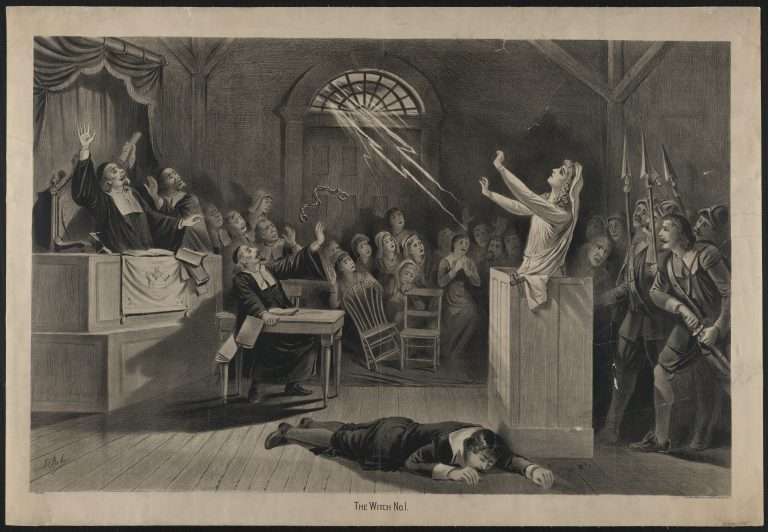
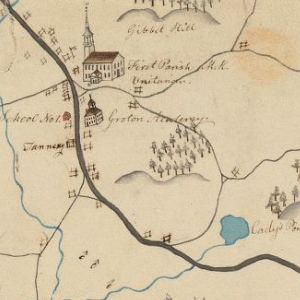
Witch #1, Lithograph, Joseph E., ca. 1837-1914
The Man Who Stopped the Groton Witch Trials
Kelsey Quinn, Groton History Center
The Salem witch trials have been talked about and debated by theologians, scientists and sociologists for the past 200 years, each field attempting to come up with an explanation to the horrific events that transpired. The most widely accepted theory among scholars seems to be that the causes of the hysteria were multifaceted or a “perfect storm”. The Puritanical colony of Salem was struggling in the winter months. Their crops were dying, there was political instability, social tension and the townspeople were drawn further and further into the madness of boredom. The Reverend Parris’s arrival sparked something in the town. All it took was for one accusation to be taken seriously by a trusted religious leader in the town for things to spiral quickly out of control. Perhaps egged on by the idea that they would get slight fame and religious attention in the town, more and more young girls began to point fingers, mostly at women who did not fit perfectly into the Puritan society. Many of these elements were present in Groton; the winter of 1671 had been harsh on the town, and with a new Reverend and increased boredom, Groton was similar to Salem in many ways. However, there was one domino that would not fall to give way to hysteria.
Rev. Samuel Willard was a Puritan minister born in Concord, Mass., in 1640. His father was a founder of Concord, making his role in the church guaranteed from birth. He was a very strong Protestant who held to the beliefs of irresistible grace and perseverance of the saints. In 1671, 20 years before the atrocities of Salem, Willard found himself in the town of Groton. During this year of preaching in Groton, he had a house of staff, as was expected for a man of his status at the time. One member of this staff was 16-year-old Elizabeth Knapp. Not much is known about Knapp before she fell into the servitude of Willard. She most likely came from a land-owning family that was wealthy enough to work for a highly regarded person such as Rev. Samuel Willard. Elizabeth Knapp was a lower middle class woman in the 17th century. Her life had been uneventful until she hit the age of 16, when she began to experience an unusual ailment. Her symptoms started out small, as outbursts and complaints of fevers, but this quickly progressed. The news of this soon reached the Rev. Willard, as shown in a letter by the reverend, describing fits of Knapp screaming and laughing in quick succession. Her outbursts started as claims that she would see people in the corner of her eye and ranged to include violent shouting about money and power, all involving the worship of the devil. She would scream obscenities at the Reverend and any male figure who neared her while she was under this condition. She claimed that she had come close to murdering her family as well as Rev. Willard.
It’s important to note that at this time the Salem hysteria was 20 years in the future, however the symptoms and behaviors of Elizabeth Knapp are eerily similar to the ones that reportedly afflicted the young women in Salem who started the 1692 trials. The similarities only grow when, further down in his letter, Rev. Willard displayed concern over Knapp pointing a finger at one of her neighbors, as Elizabeth Parris had done. The difference between this case in Groton and Parris’s case in Salem is Reverend Samuel Willard. Willard refused to be the fuel to the spark of Knapp’s accusations. He quickly shut down these accusations saying he knew the accused woman personally and knew that she was a godly woman. He even went so far as to omit her name from any correspondence or record of the event as a snippet from his letter to his superior told, “shee seemed to impeach one of the neighbors, a person (I doubt not) of sincere uprightnesse before God.” Although this may not seem like a history-changing decision, it very much is.
The complexities of Elizabeth Knapp’s story can be traced all the way back to ancient Rome. The concept of witchcraft did not originate in Salem or Groton, Massachusetts. The first notable scare of witches was in the aftermath of the fall of paganism in Rome. To convert the largest and most powerful nation in the world into a monotheistic religion took a lot of time and effort. To help this along the Catholic leaders transformed Paganism to an active anti-Catholic force. Symbols like Neptune’s trident were vilified and used as the Devil’s pitchfork. It is this period in time where the concept of “Satan worshipper” or “witch” became culturally present. The label became popular after the publication of Malleus Maleficarum by Heinrich Kramer in 1486, the title translating to The Hammer of Witches. Although the original publication of the book was in Germany, it began to spread throughout Europe. Hysteria started to rise when the book was published in Florence, Italy, a city that was already known for its strict religious practices and frequent paranoia. This book posed the question that witchcraft was not individual, but rather intensely tangled with Satan himself, framing anyone who was labeled as a witch as part of a larger scheme to take down the Catholic church in the name of the devil. Malleus Maleficarum also cements women as the main victims of the devil. This creates a situation in which women who were outside of the social norm could be accused of witchcraft and burned at the stake. This includes but is not limited to unwed women past the age of 20, widows, women who skipped Sunday Mass, women who did not go outside, women who went outside too much and any women with a form of education. This time period in Florence is integral to the later happenings in Salem. The classic imagery of witches started and eventually snowballed (pointed hat, riding on a broomstick, etc.) as well as the vilification of the “others” in religious society. Since that time, accusations of witchcraft have been tossed from society to society, culture to culture, coming in many different forms, but none amounted to the mass hysteria seen in Renaissance Florence— until Salem.
Elizabeth Knapp is not any kind of villain in this story. Knapp was a young woman who was oppressed from every angle, she was a pressure cooker with very few options to let off steam. While reasons women like Knapp had for pointing the finger at neighbors, friends or relatives, are largely unknown, a popular theory supported by scholar Deborah Willis in Malevolent Nurture: Witch-Hunting and Maternal Power in Early Modern England is that these women had no choice but to be tools in the patriarchy in order to survive. There was a continuation of a cycle of violence they were subjected to by being second-class citizens in an already struggling society. Screaming and throwing fits, these girls could have been communicating their frustration in the only way they could, having nervous breakdowns that were interpreted as possessions of the devil.
When Reverend Samuel Willard stopped a witchcraft accusation in its tracks, he stopped a cycle that pitted people, especially women, against each other on behalf of societal standards. Willard perhaps inadvertently quelled the mass hysteria that was at a boiling point in Groton by refusing to use his position of power to turn these accusations into anything more than they were, a cry for help from a psychologically sick young girl. Reverend Samuel Willard went on to leave Groton shortly after these events, however he kept his set of beliefs with him as he traveled preaching around Massachusetts. He is known mostly for his writings staunchly opposing the Salem Witch Trials as they began to happen. While the New England witch trials raged on, Groton was relatively quiet, still steeped in religious practices yet with no documented incidents of possessions or witchcraft. It’s impossible to know for sure, but it is likely that the role Reverend Samuel Willard had in the Elizabeth Knapp case played a key role in quelling what could have become the Groton Witch Trials.
Author Bio:
Kelsey Quinn is a recent graduate from Trinity College Dublin, where she majored in History of Art and Architecture. She has been a collections intern at Groton History Center for four months. During her time at Trinity she focused heavily on the origins and depictions of witchcraft in art as well as in texts, through this article she brings her areas of study together to explore the complexities of this subject and its connection to Groton.
Sources
Green, Samuel Abbott. Groton in the Witchcraft Times. Groton, MA: University Press, 1883. https://history.hanover.edu/texts/Willard-Knap.html.
Mixon, Franklin G., Jr. “Weather and the Salem Witch Trials.” Journal of Economic Perspectives 19, no. 1 (2005): 241–242. http://www.jstor.org/stable/4135002.
Willard, Samuel. “A Briefe Account of the Case of Elizabeth Knap of Groton.” Hanover Historical Texts Collection. Hanover College. https://history.hanover.edu/texts/Willard-Knap.html.
Willis, Deborah. Malevolent Nurture: Witch-Hunting and Maternal Power in Early Modern England. Ithaca, NY: Cornell University Press, 1995. https://cornellpress.cornell.edu/book/9780801430046/malevolent-nurture/.
Kraft, Nathen. “Devils in the root cellar: The strange case of the Groton Witch, 1671.” Brown University, Creative Nonfiction, Spring 2001. https://cds.library.brown.edu/projects/CreativeNonfiction/spring01/kraft2.html.