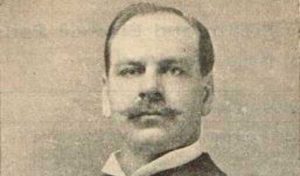
No one has left a more enduring footprint or indelible mark on the town of Groton than William Pickman Wharton (1880-1976), though few people are alive today who knew him during his 70 years as a Groton resident. Known to his friends as “Billy,” he was deeply committed to forest conservation and preservation and to land use planning and management. He is remembered in town today more for the results he brought about in these areas of concern than as a figure about town. He was a rather private person.
In 1968 Wharton gave land, since called Wharton Plantation, to the New England Forestry Foundation, which he had helped form back in 1944. The year 2018 will mark the Foundation’s 50th anniversary of managing this woodland to keep the forest thriving while allowing for the marketing of saw logs, cords of wood, and wood chips and also providing a system of trails for the public to enjoy.
William Wharton came from a background of privilege. He studied at Groton School while Franklin Delano Roosevelt was a student there, and earned a Bachelor’s degree at Harvard College in 1903. He had a vocation in law, but he also was worth several million dollars by the time he took up residence in Groton. Rather than buy into a business, indulge in investing, or spend lavishly on exceedingly expensive goods or grandiose living accommodations, he put his money as well as his intellect to work seeking ways to protect and preserve nature.
Bedrock for his love of nature was his fascination in birds. He became a licensed bird bander, establishing a banding station at his home, Five Oaks Farm, on Broadmeadow Road. It was an easy step from attraction to birds to an appreciation of their habitat. At the age of 90 he declared he had “never found anything more interesting…than my work in conservation…or more satisfying.”
Wharton was also important in the formation of the Massachusetts Forest and Park Association in the 1930s, since 1993 operating under the name Environmental League of Massachusetts. Causes important to Wharton are stated in a March 6, 1937, search for new members: To get everyone in the state “interested in protecting and improving the forests” and working for “the establishment and proper development and the preserva-tion of natural scenery.” The organization was aiming to fight Dutch elm disease, fund economic and geological surveys of the state for farmers, work to prevent forest fires, maintain bridle paths, open more public beaches, and many more specific causes.
How best do we honor such an important person? Perhaps most fitting for our remembering this man, so modest about himself, is to walk in “his” stamping grounds as we remember his love of birds and nature, being mindful of his assistance in making us able still to see something of what he saw of wonder and beauty in this world.