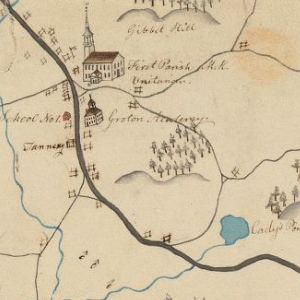
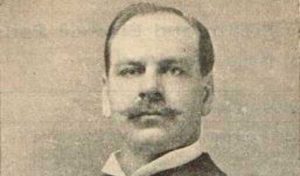
Major General William Amos Bancroft, a notable 19-century native of Groton, was born on April 26, 1855, and died on March 11, 1922). He achieved great success elsewhere in business, politics, and the army, but retained a love for his hometown and hoped to retire there. This led him to design a summer estate to be built on the very land where he was born, on Main Street next to the home and farm of his friend and contemporary, Gov. George S. Boutwell. Bancroft bought back the family property and some adjoining farms on the side of Gibbet Hill, and in 1902 began building his dream house, starting with the gates and gatehouse for his estate on Main Street and the carriage house and stables high on the hill.
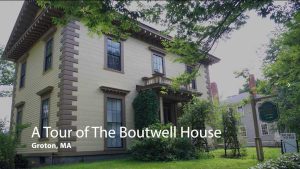
The gates and gatehouse are still on Main Street, next to Boutwell House. A plaque on the gates reads: “To the fond memory of [his parents] Charles Bancroft 1802-1873 and his wife Lydia Emeline (Spaulding) Bancroft 1822-1895.” William Bancroft was descended from the first Bancroft to ever reach New England in the 1630s, and as such was a scion of an old and prominent New England family. Gov. Boutwell once wrote that Bancroft was “a worthy member of a worthy family.”
Bancroft graduated from both Harvard College (1878) and Harvard Law School (1881) and was soon on the Cambridge Common Council (1882-1883) and in the Massachusetts House of Representatives (1883-1885). He then en-tered the field that would earn him his fortune: transportation. He served as superintendent of the Cambridge Street Rail-way, then roadmaster of the West End Street Railway (which became the Boston Elevated Railway), overseeing the im-plementation of electric trolleys during his tenure there. Bancroft returned to his law practice, as well as politics, serving on the Cambridge Board of Aldermen (1891-1892) and as Mayor of Cambridge (1893-1897).
Bancroft earned the title of Major General through his service in the Massachusetts militia, beginning in 1875 when as a freshman at Harvard he enlisted as a private. He served in the Spanish-American War, retiring in 1901 with the rank of Major General.
However, Bancroft’s true fortune came from the Boston Elevated Railway, of which he was president from 1899 until 1916. A friend once said of him, “He was quick to rebuke, but equally quick to reward success. He possessed an almost unlim-ited capacity for detail and his name was a synonym for rugged honesty and a square deal.”
Though Bancroft lived in Cambridge, he retained his dream of retiring in Groton. He completed construction of a large stone house with a handsome tower and had plans drawn up for a massive mansion on the peak of Gibbet Hill, plans which still exist at Boutwell House. But it was not to be. In 1908, for un-known reasons, he stopped his building project.
Gen. Bancroft died in Cambridge in 1922 and is buried in Groton cemetery next to his parents. The castle had been sold in 1918 to Dr. Harold Ayres, who ran it as a long-term recovery hospital, and then in 1928 it was bought by the Groton Hunt Club. It burned on the evening of July 4, 1930, after trespassers on the property set off firecrackers. Stone walls and the hollow tower remain as evidence of his dream.