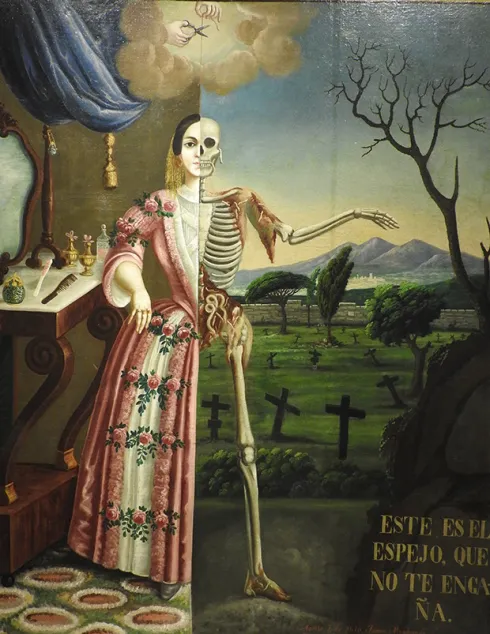
Alegoría de la Muerte (Allegory of Death), Tomás Mondragón, 1856
The Graveless Man
Kelsey Quinn, Groton History Center
Richard Sturtevant was reportedly an only child of deceased parents, an odd man with questionable ties to Groton, Massachusetts. According to an April 9, 1909 article published in Turners Public Spirit (printed in Ayer, MA), an odd incident had just taken place: Richard “Dick” Sturtevant died. He was touring the town’s electrical plant when he tripped, grabbing onto an unprotected live rod conducting “about 10,000 watts of electricity” through his body. There were attempts at resuscitation, but ultimately, he was carried to a nearby boarding house and locked in a vacant room. When the town coroner arrived five hours later, the room was still locked and empty. Panic rose in the town as the hunt began.
Sturtevant’s fiancée, Miss Minton, began a search for the body of her would-be husband. The search turned up nothing; the body had simply vanished. The most likely conclusion was the one already spreading throughout the town: that a nearby medical school had stolen the corpse for study.
But why would such an immoral and absurd notion be widely accepted? To explain that, we have to look at the politics of “corpse stealing.” Massachusetts has long been a centre of medical practice and discovery; however, laws and regulations stifled the means to practise certain aspects of this craft. Until 1831, medical students were mostly limited to criminals dead from execution for autopsies; this left a vast shortage of corpses, as they were only viable for a short amount of time and could not be easily transported from place to place. However, a Massachusetts law in 1831 decreed that not only could victims of the death penalty be used for medical study, but so could unclaimed bodies; meaning people who died with no one willing or able to bury them became medical specimens. This caused a problem, as many of these unclaimed corpses were those of the impoverished who deserved to be buried in a way that aligned with their individual beliefs. As Ruth Richardson says in “Death, Dissection and Destitution”, “dissection became a punishment for poverty.” Corpses became commodified; the treatment of them grew increasingly inhumane in the name of scientific discovery.
Townspeople were eager to assume Richard Sturtevant, who would have been claimed if left but not greatly missed when gone, was stolen. However, that is not what happened, and Sturtevant’s story is far from over…
In the year following Sturtevant’s death and disappearance, his fiancée, Miss Minton, appeared unmoved by his absence, shedding her mourning clothes as soon as society allowed her to. Rumours spread that Miss Minton had a secret new fiancé, whom she must have met soon after Sturtevant’s death. This caused an uproar in the community, as her dead partner did not even have a grave to speak of, yet she had already moved on. In retaliation for this gossip, Minton refused to publish the name of her new beau and, in fact, sent out wedding invitations with the groom’s name missing. Few people attended her nuptials, as the situation was incredibly gauche, but those who did experienced the shock of a lifetime. When the church doors opened to reveal Miss Minton’s soon-to-be groom, none other than Dick Sturtevant stood in the doorway! The undead groom went on to marry his longtime fiancée.
The “undead” didn’t originate in the small town of Groton. The idea of a corpse “reanimating” has long been around. Medieval understandings of death differ greatly from how we think about it today. Death was not straightforward; resurrection is woven into both the pagan and Christian religions. These ideas did not work in opposition; instead, medieval Europe combined them to create a genre of the “undead” called “revenants”. The people most at risk of rising from the dead were mostly those who suffered traumatic or unusual deaths; Catholic reasoning for this was that their deaths were shrouded in sin. A limited understanding of decomposition at this time could scientifically explain this phenomenon: unusual causes of death caused unusual rates of decay in corpses, making people believe that there was something unnatural about their postmortem bodies. Fear of these creatures came from plagues and sicknesses that could spread through dead bodies, creating both the pathogenic nature of supernatural creatures and the destructive ways they had to be disposed of.
In Haiti, beliefs about the dead and undead developed along a different path, as African spiritual traditions encountered Christianity and the brutal realities of enslavement in the Caribbean. These separate trains of thought combined when enslavement of the Haitian population began in the Caribbean. This new culture combined Haitian beliefs about witchcraft with Christian understandings of sin. It gave rise to the idea of the zombie (from the Haitian Creole word zonbi, associated with the living dead). The original concept of a zombie was heavily influenced by Vodou practices, as Haitian culture at the time held that a zombie was simply the body of a deceased person, puppeted by someone else to do their bidding. This also connected heavily with the oppression and control the enslaved Haitians were facing, believing themselves to be spiritually dead yet still controlled by unnatural forces. This evolved through popular culture (mostly movies in the early to mid 1900s) to become what we now think of as a classic zombie.
By all accounts, however, another force did not control Richard Sturtevant, nor was he prone to cannibalism, so he likely did not succumb to this particular facet of the undead.
Zombies were not the only form of “revenants” that would have been popular in Groton’s cultural zeitgeist at the turn of the 20th century. Vampires had been taking over Western culture in recent years. In the 1700s, the vampire myth began to take shape. Eastern Europe struggled with crop failures, long winters, and plagues. Naturally, myths took root that a supernatural creature was behind it all. People claiming they saw their undead loved one through a window at night started to have serious weight as a claim, so much so that small towns began to dig up these supposed ghosts, to find that they had not decomposed exactly as expected; some even sporting blood around their mouths. We know now that this is most likely the cause of unusually cold weather and livor mortis due to traumatic deaths. This discovery caused what is now known as the “18th-century vampire panic”, where government authorities would confirm several cases of vampirism to the public. At the time, vampires were reported to be unusually red, with long nails and hair, but they did not drink blood to survive; instead, in some accounts, they would bite to spread their disease through the town. This panic eventually settled, but in 1897 Irish author Bram Stoker used it to write his famous book, Dracula, a text that cemented modern vampire lore.
Fortunately, Sturtevant did not return with a bloodlust and successfully stepped into a church for his marriage ceremony, so it’s safe to say that his holy spirit remained intact.
Although Dick Sturtevant was decidedly not a vampire or a zombie, he does have one thing in common with them… he is likely mostly made of myth! That’s right, you’ve been sold a story, much like people across the country were when this syndicated short story was published next to their “about town news” in the local newspapers. Now, although this story is not confirmed to be true or false, we can tell you that, through our research, there was no man by the name of “Richard Sturtevant” in local town records; this could be because he is merely a character in a spooky story or maybe because his unnatural life (and death) was too conspicuous to be properly noted. The story’s connection to Groton stems mainly from the 2001 publication Forgotten Tales of Groton in which Charles Emil Ruckstuhl speculates about local details in the 1909 newspaper article. But still keep an eye out for any strange night dwellers on Main Street this Halloween!
Author Bio
Kelsey Quinn is a recent graduate from Trinity College Dublin, where she majored in History of Art and Architecture. She has been a collections intern at Groton History Center for four months. During her time at Trinity she focused heavily on the origins and depictions of witchcraft and related practices in art as well as in texts, through this article she brings her areas of study together to explore the complexities of this subject and its connection to Groton.
Sources
Caciola, Nancy Mandeville. “Afterlives: The Return of the Dead in the Middle Ages.” Ithaca, NY: Cornell University Press, 2016. https://archive.org/details/afterlivesreturn0000caci.
Richardson, Ruth. “Death, Dissection, and the Destitute.” 2nd ed. Chicago: University of Chicago Press, 2001. https://archive.org/details/deathdissectiond0000rich_j1z4.
“The Man Without a Grave.” Turner’s Public Spirit, April 10, 1909, Ayer, Massachusetts, newspaper archive, Advantage Preservation, https://ayer.advantage-preservation.com/viewer/?k=dick%20sturtevant&i=f&by=1909&bdd=1900&d=01011909-12311909&m=between&ord=k1&fn=turners_public_spirit_usa_massachusetts_ayer_19090410_english_7&df=1&dt=1&cid=3140
Cook, Denise N. “The Cultural Life of the Living Dead.” Contexts 12, no. 4 (2013): 54–56. http://www.jstor.org/stable/24710865.
Ruckstuhl, Charles Emil. Forgotten Tales of Groton, 1676–1941. Groton, MA: Charles Ruckstuhl Co., 2001.