When you spend so much time in the same place with the same surroundings, you tend to become blind to what is right in front of your eyes. Last fall, as we prepared the Boutwell House for new wall and floor treatments, we moved furni-ture that hadn’t been shifted in years and uncovered treasures that hadn’t recently seen the light.
In the Grant Bedroom at the Boutwell House is a 19th century sleigh bed with as interesting a history as one could expect from a utilitarian piece of furniture. On June 16, 1869, President Ulysses S. Grant slept in the bed when he visited George Boutwell, his new Secretary of the Treasury. The bed was later used for decades by Georgianna Boutwell until her death in 1933. The faded mattress still bears the ghostly outline of its former owner.
Perhaps born out of a sense of preservation (some experts recommend laying quilts flat instead of folding them) or a sense of necessity (who needs expensive archival boxes?), someone had layered five quilts on the bed that were not seen until we peeled back the corners one by one. Oh, my!
Off to the Quilt Museum for Assessment
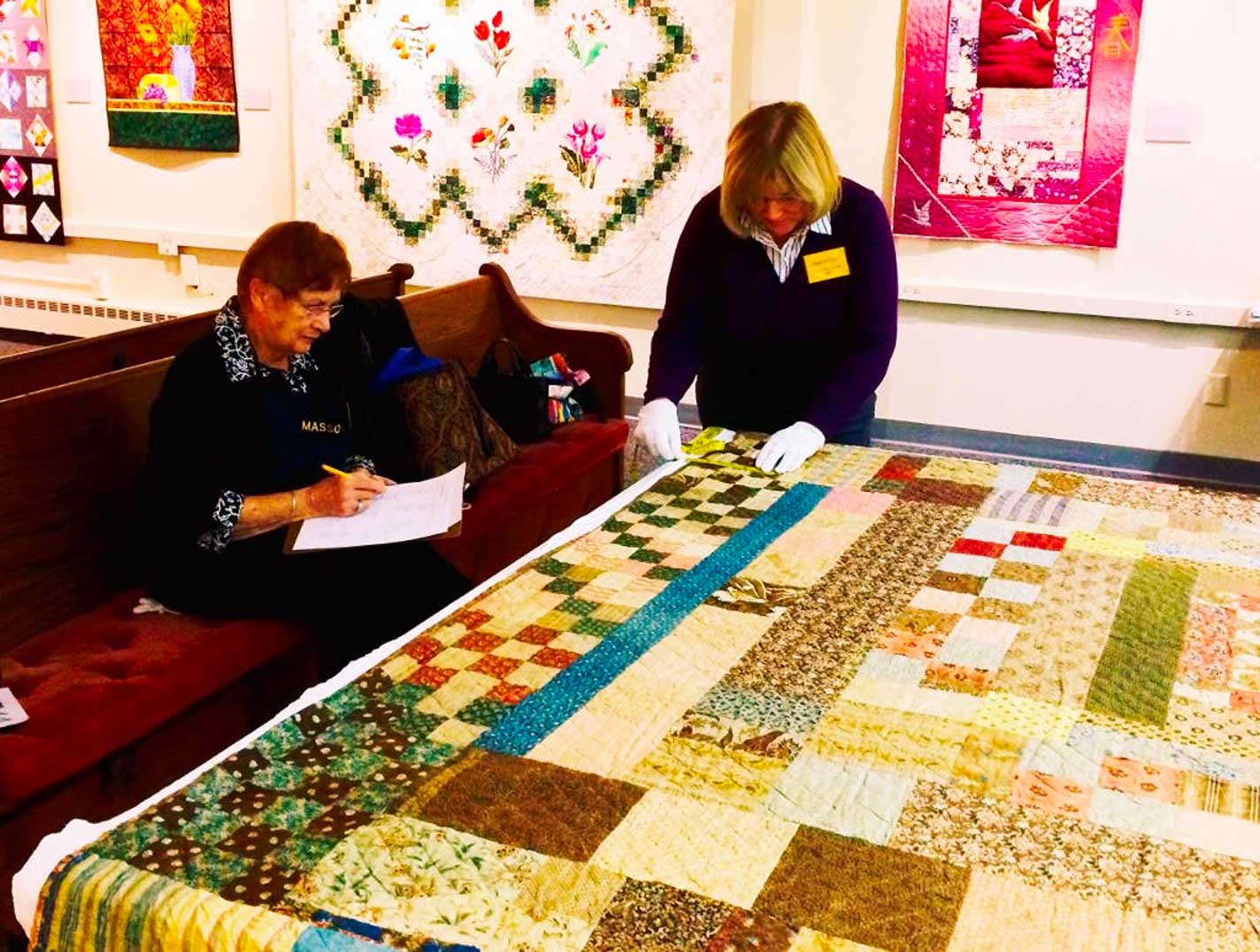
Intrigued by the possibility of new stories to uncover, we gathered up the old quilts and all pertinent information on them and arranged to bring the quilts to the New England Quilt Museum in Lowell for evaluation through their Mass-Quilts Documentation Project. Well-versed volunteers at the museum received our quilts and began their evaluation by first hanging the quilts one by one, photographing them, then laying them out for further inspection.
While examining the quilts, the volunteers recorded reams of technical information including technique, layout, fabric, patterns, and motif. An approximate construction date was provided for each quilt based on the findings. All of this information greatly enhanced the limited descriptions we had in our own database at the Boutwell House.
We learned that the five quilts we brought in for evaluation were made at various dates between 1830 and 1900. Patterns include Sawtooth Star, Center Medallion, and Broken Dishes. Valuable information such as fiber type and con-struction technique, which fell outside our own expertise, was clearly detailed for us on catalog sheets that we will add to our own Collections files.
Caring for Old Quilts
Perhaps just as valuable as the technical and design information is the care, storage, and cleaning guidelines we were given. Aside from the usual concerns for textiles (such as light, pests, and climate), we also learned about special consid-erations for storage and display. Long-term folds can be damaging to fibers, we were told, and stacking quilts can easily crush the fabric. Plastic, unsealed wood, and cardboard all pose threats due to off-gassing and moisture entrapment. Ideally quilts ought to be wrapped in a white sheet, interleaved with acid-free tissue, stored in archival-quality boxes, and taken out every six months to be aired out and refolded. Not your usual linen-closet routine.
The Massachusetts Quilt Documentation Project seeks to document the different examples of quilts that were produced in the state before 1950. With the inclusion of data on the five quilts we found in the Grant Bedroom, that as-pect of Groton material and domestic culture is put into the context of the greater community. By bringing these quilts for evaluation we have done our duty to conserve and protect them, and by contributing knowledge to a grander statewide project, we are fulfilling our obligation to share the history of Groton.