










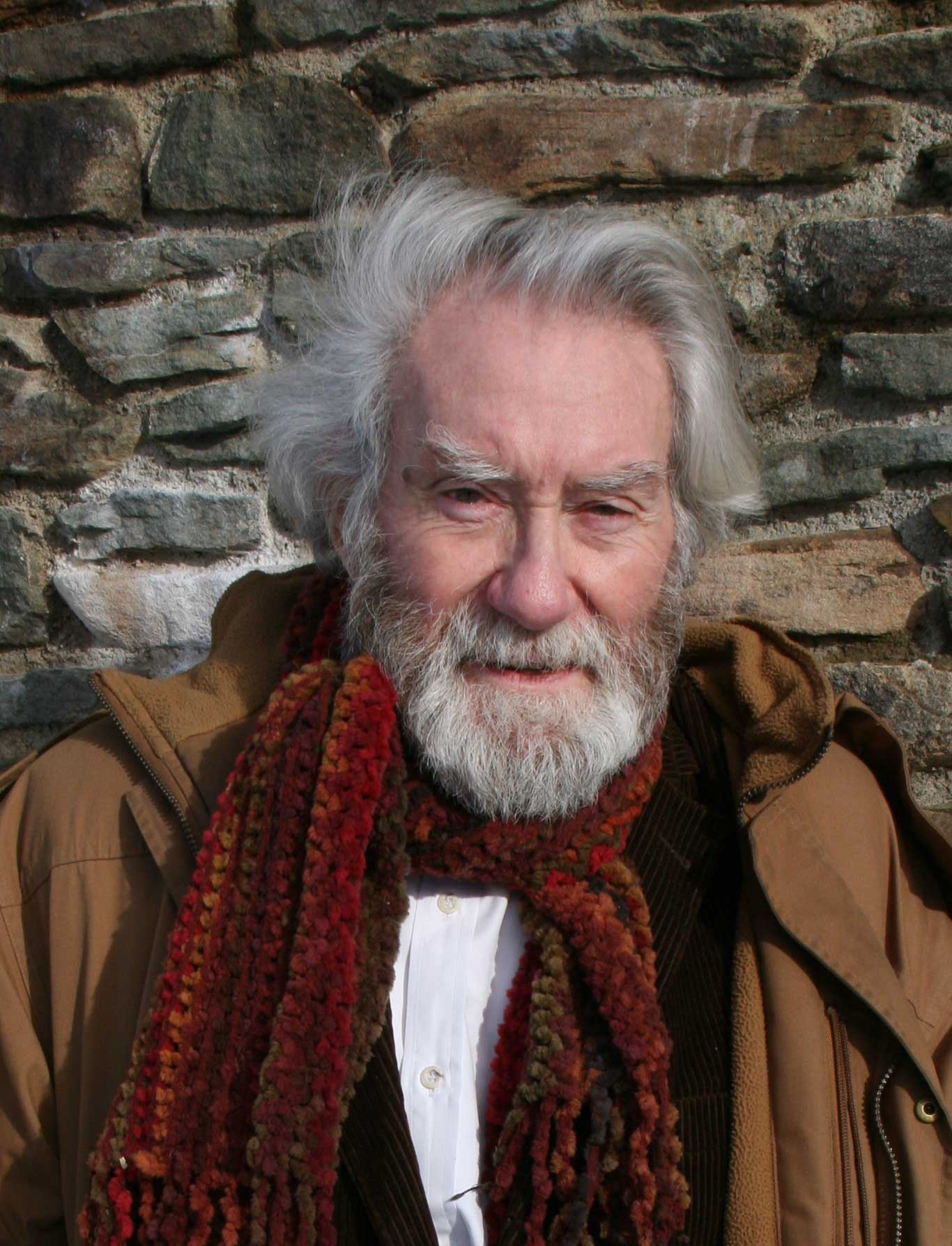




Character & Community
-

- Dr. Harold W. Ayres
-
- Earl Carter
-

- Emma F. Blood
-

- Georgianna A. Boutwell
-
- Elizabeth S. Hill
-
- Leroy Johnson
-

- Virginia A. May
-
- Otto Plene
-

- Harvey Sargasso
-
- William P. Wharton
Exhibited March 2024
Towns are shaped by the people who live and work there. For more than 350 years Groton has been home to farmers making a living, men and women fighting for the future of their town and country, politicians lobbying for new policies, and dedicated historians detailing important events. Both publicly important and charmingly ordinary people have molded Groton into the town it is today.
In Character & Community, meet ten Groton residents who left their mark on the town during the 20th century. Their names may not all be familiar, but they all listened to the pulsebeat of the town, and anticipated the challenges to come. Each put their time, energies, education, and, in some cases, personal finances, toward protecting natural resources, promoting social services, preserving history, making art accessible, furthering the opportunities for lifelong learning, and cultivating the skills for survival in a changing world.
Dr. Harold W. Ayres - A Doctor With A Vision
-
- Dr. Harold W. Ayres
What we know of Dr. Harold Ayres (1881-1966), the beloved physician who made house calls in Groton, Pepperell, and Townsend is inextricably linked to the varied fortunes of the ruins currently known as the Castle on Gibbet Hill.
Born in Somerville and a graduate of Harvard Medical School, Dr. Ayres moved to town in 1913. He served Groton for more than fifty years as school physician, as a member of the Board of Health, and as a home labor-and-delivery doctor. He and his wife, Pauline (who he called Paul) lived at 113 Main Street, in the brick Federal-style home on the corner of Broadmeadow Road.
A local success, Dr. Ayres nurtured a larger vision. When Groton native General William Bancroft’s dream of retiring to the mansion he envisioned for himself on the crest of Gibbet Hill, went awry in 1918—Bancroft got only so far as the stone tower and a bungalow before he ran short of capital—Harold Ayres stepped in with a plan of his own.
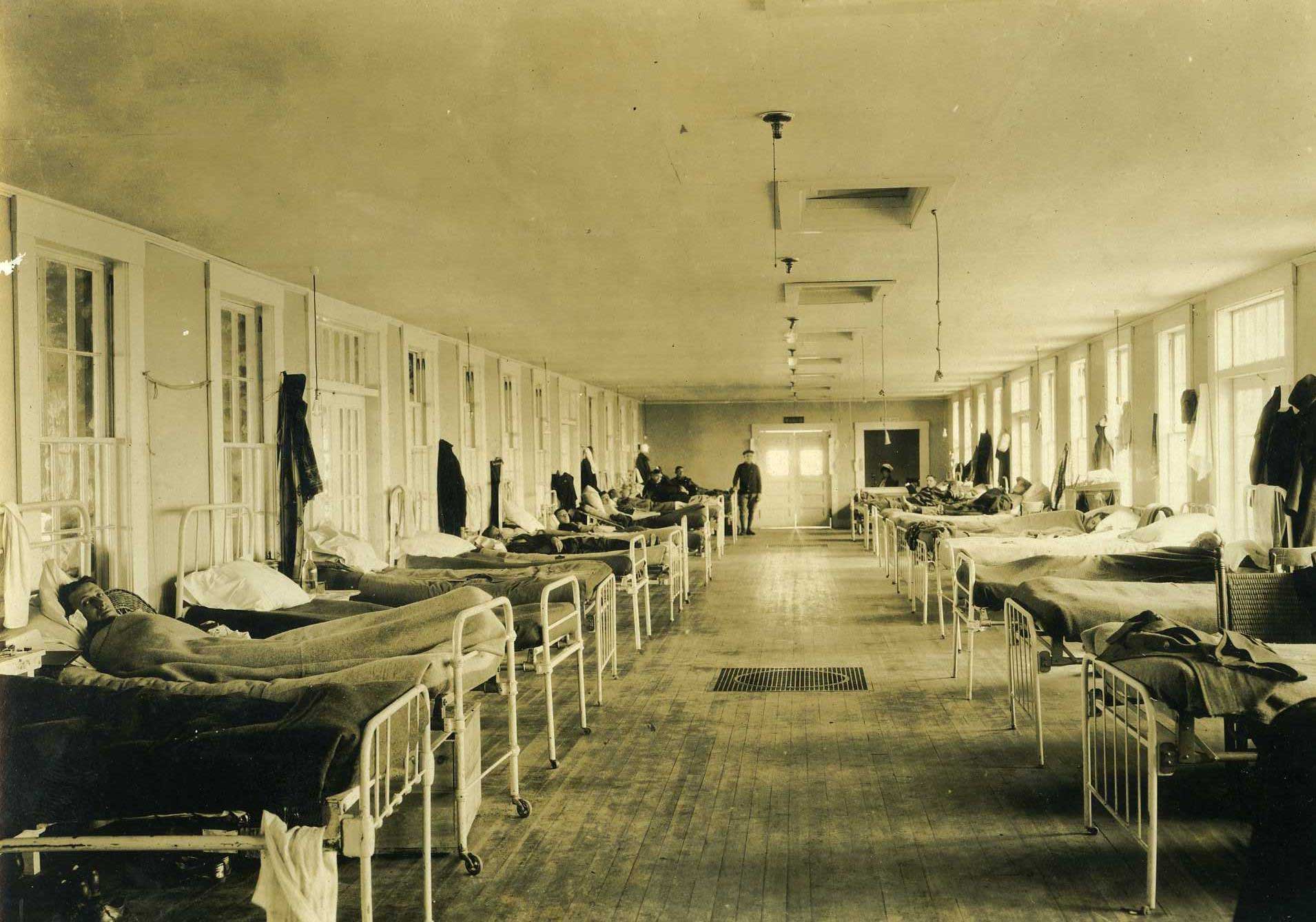
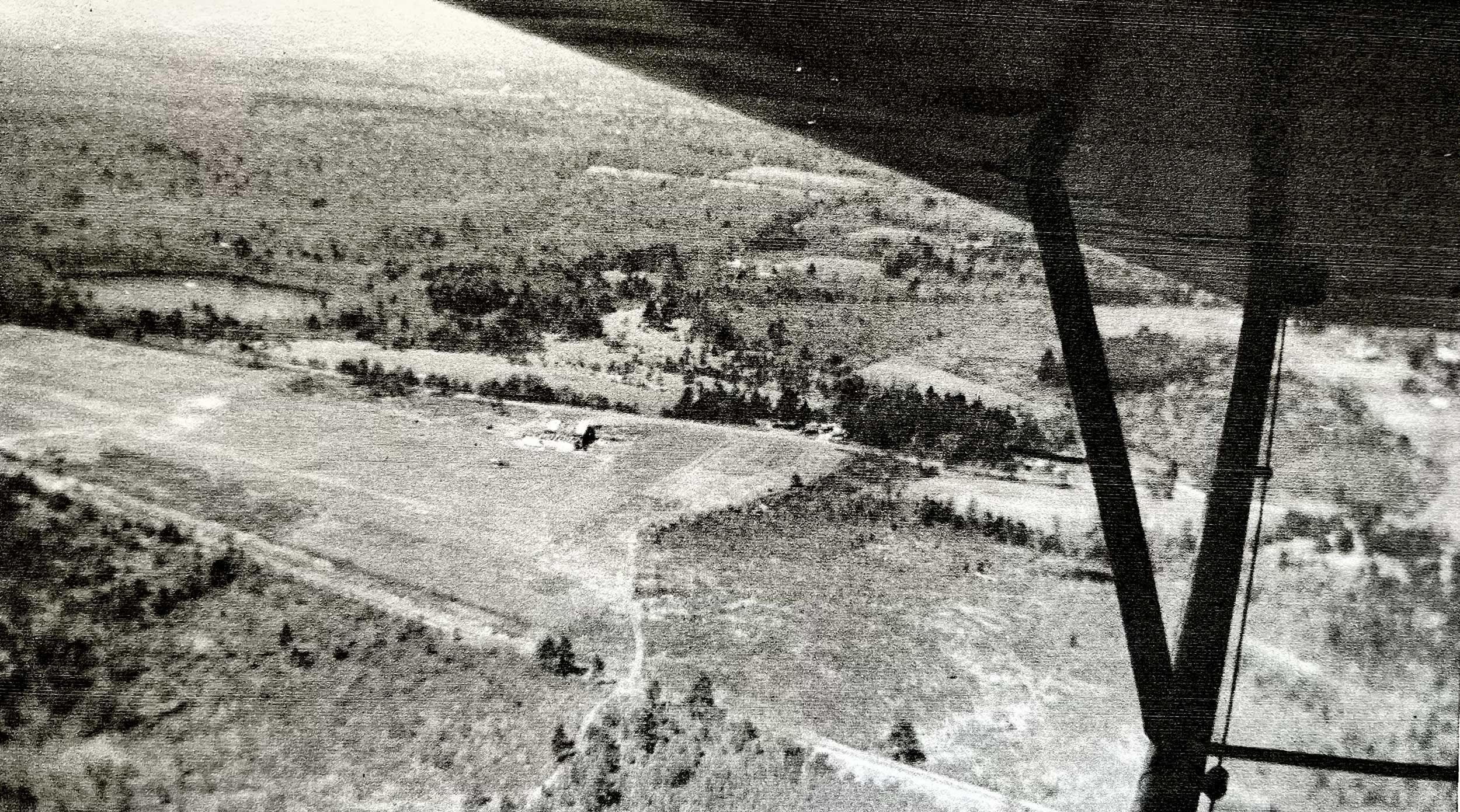
Dr. Ayres bought and transformed the half-built property into a hospital modeled on the re-cuperative practices of the time, advocating a regime of fresh air, rest, and exercise. Whether the Groton Private Hospital, so called, was a tuberculosis sanitarium, or as others claim, a treatment center for wounded soldiers, or—still another hypothesis—it served as a getaway for the wealthy, remains uncertain. It is recorded, Dr. Ayres accepted “all but [the] insane or contagious” for $20 a week. Whatever its mission, the private hospital appears to have been a success, fostering various enterprises on the hill including the adjacent stone house Dr. Ayres built for himself and Paul. Here, on the stunning south-east-facing slope of a geologically sig-nificant nest of drumlins, he ran a vegetable and livestock farm to provide for his patients.
In the early 1930s, Dr. Ayres must have either run out of energy, funds, or both because he sold the hospital to the Groton Hunt Club, which used it for fox hunting, parties, and other fes-tivities. In 1932, an errant spark from a July 4th celebration caught fire and destroyed the bun-galow. All that remains are the ruins—the vine-laced observation tower—a symbol of Ban-croft’s dream and Dr. Ayres’ reach for something larger than his hometown practice.
Dr. Ayres kept meticulous accounts. His Ledger Collection consists of fourteen volumes related to his medical work, including financial records, medical and patient information, diary entries, and notes about his construction projects, farming pursuits, and travels. In the summer of 2023, the GHC received invaluable assistance from Allison Hall, a graduate student of Library Science and Public History who inventoried and catalogued this revelatory material.
Earl Carter - The Man Behind the Myseum
-
- Earl Carter
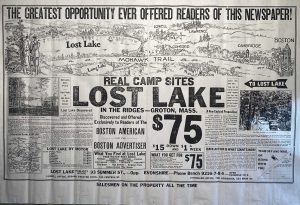
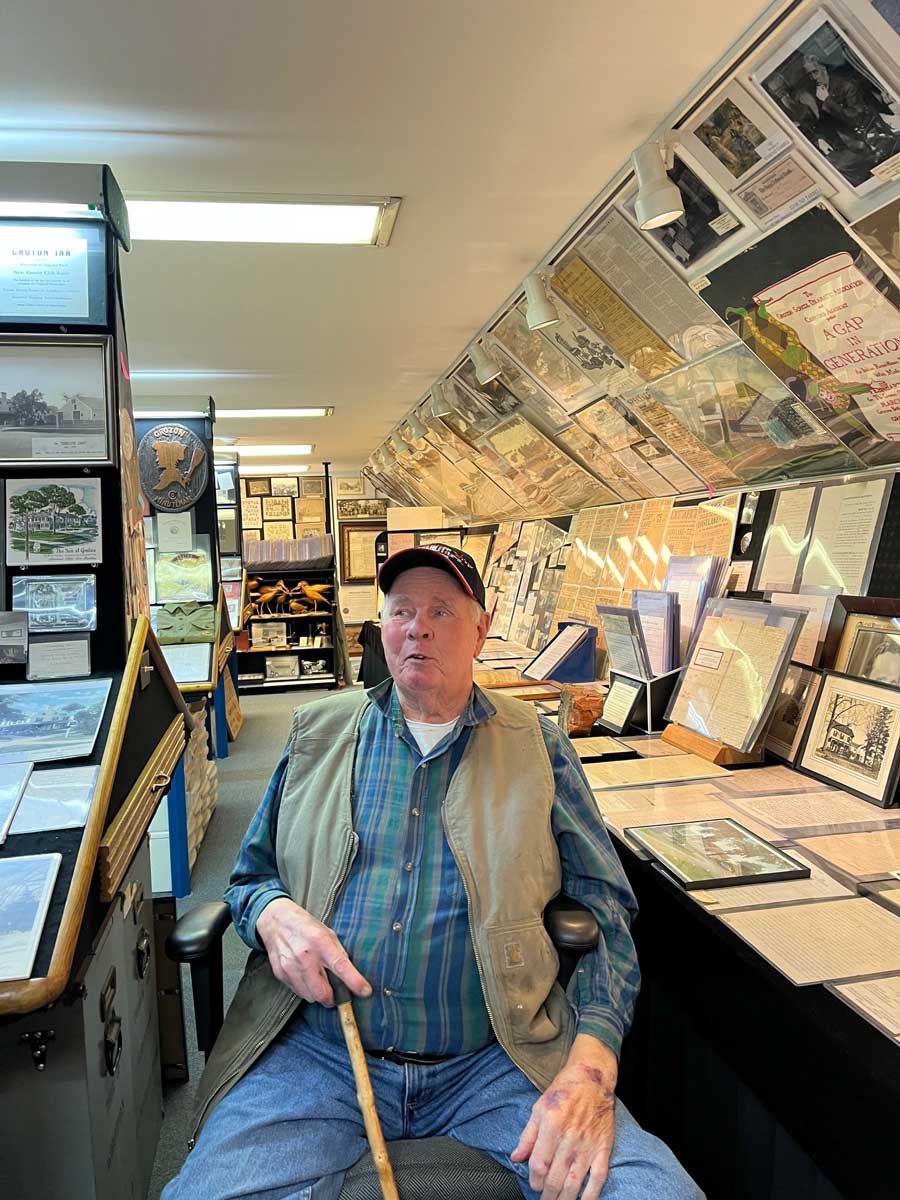
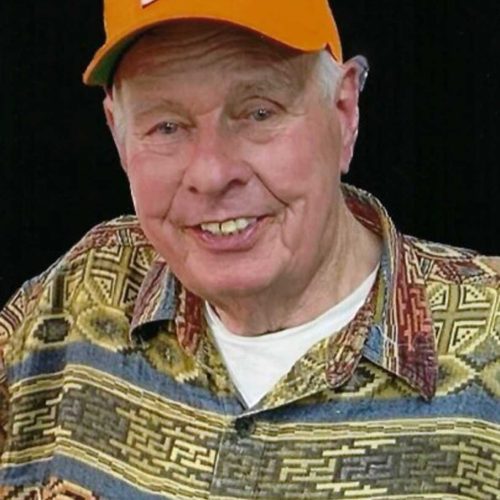
Earl Carter (1939-2024) was born in Boston in 1939 to Donald Fremont Carter and Ruth Irene Carter and grew up in Malden. Earl was a successful business owner, a car enthusiast, and a champion of Groton’s unique Lost Lake Community.
A dedicated collector of Groton artifacts, ephemera and memorabilia, Earl built and maintained the Myseum: a mu-seum dedicated to Groton’s history. He was thrilled to share his collection with anyone and everyone: whether inviting researchers to visit or setting up displays in the community. The Groton History Center frequently benefited from his expertise and willingness to lend items from his collection for exhibits.
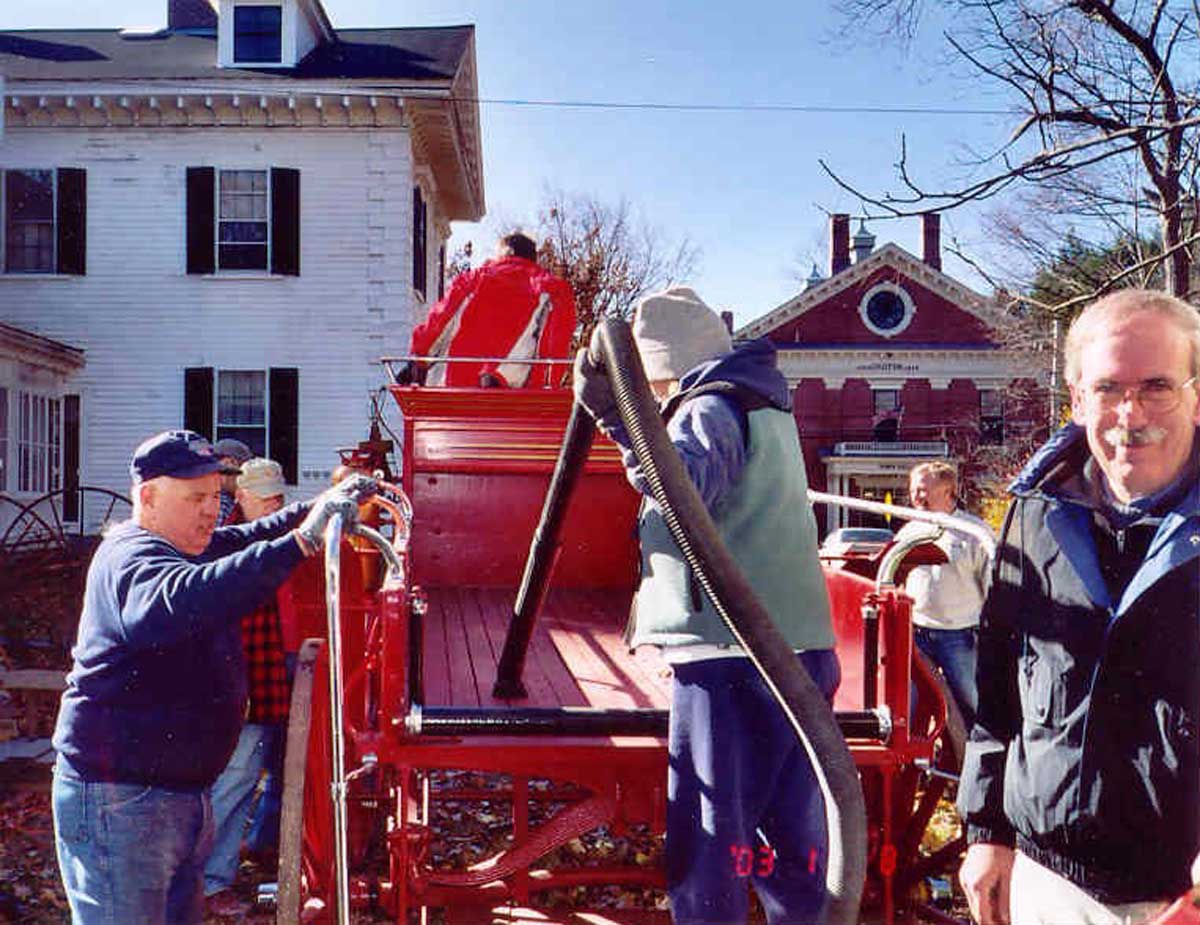
With his love for history, it is no surprise that Earl found his way to the Historical Society. He served as curator of the Society during the early 2000s. During those years he worked on countless exhibits and preservation projects in-cluding the stabilization and restoration of an 1850s stagecoach that belong to the Lawrence Family. These projects and others like it in the community demonstrate Earl’s conviction that history belongs to the people and should be accessible to everyone.
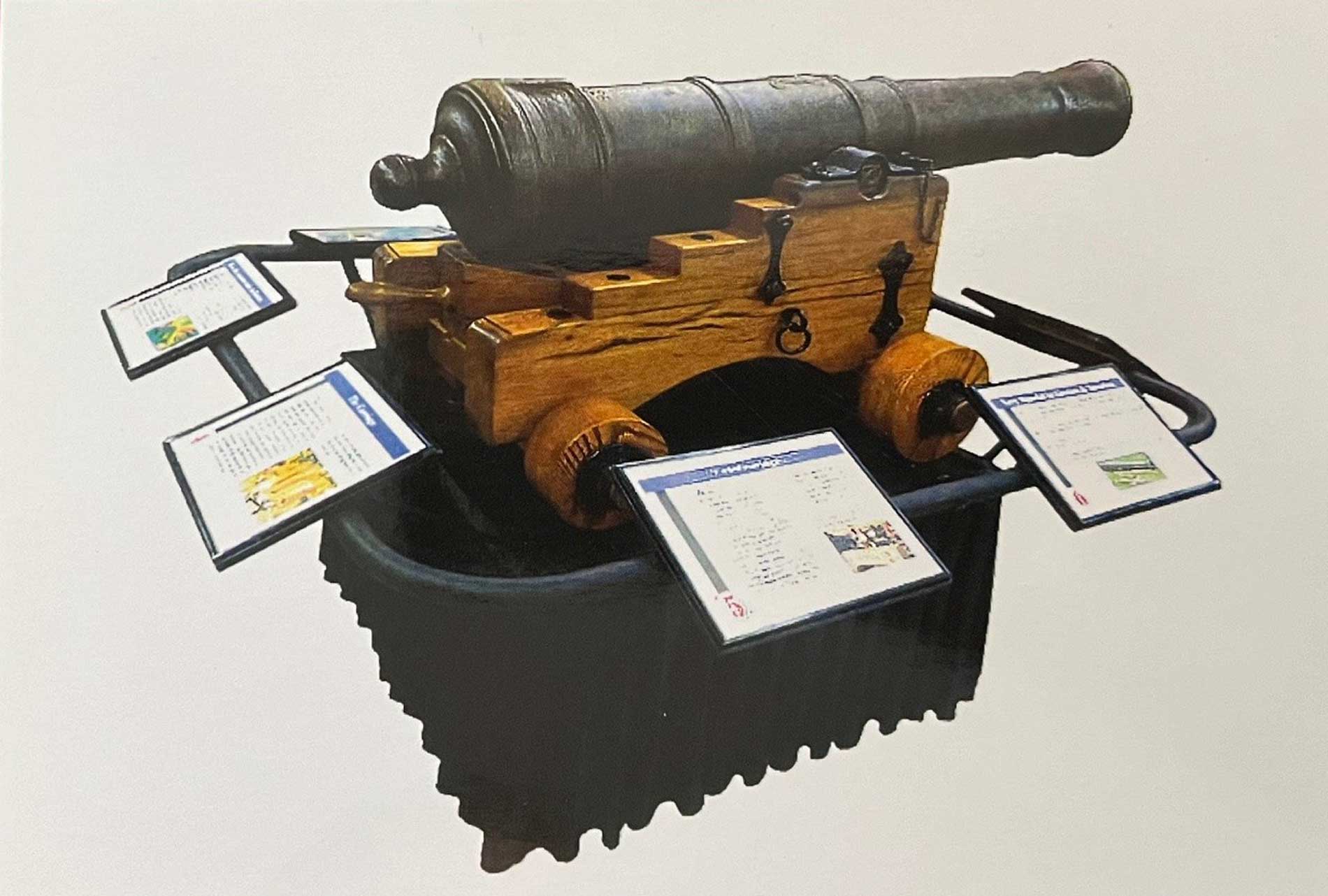
Through his meticulous research and his skills as a precision machinist, Earl restored a revolutionary cannon. The cannon, with a cartouche of King George’s royal seal was captured from the H.M.S. Diane by soldiers from Groton under the command of Captain Asa Lawrence on May 28, 1775. The cannon sat for many years covered in vegetation and dirt, before Earl recognized its importance to Groton’s history, did extensive research and restored it. You will some-times find it displayed at the George Boutwell House along with a detailed explanation of its discovery and history.
The First Parrish Meeting House benefited from Earl’s expertise when he removed the bro-ken steel clock from the steeple, restored and rebuilt it. While it took a number of years, today you can hear the bell strike every hour. In addition, Earl helped repair the historic Chicopee School house by rebuilding the wellhouse, the privy, and stone walls.
In 2012 Earl received the R.W. Lewis Award for Outstanding Citizen of Year. He will be remembered for contributing his talents and expertise to the betterment of the Groton Community. Earl always remained a dedicated resource for the Groton Historical Society, answering our questions, donating materials to us, allowing us to borrow items for display and sharing his knowledge of the Town’s history and the history of our organization.
Earl has a well-earned place in Groton’s history.
Emma F. Blood - A Librarian of Influence
-
- Emma F. Blood
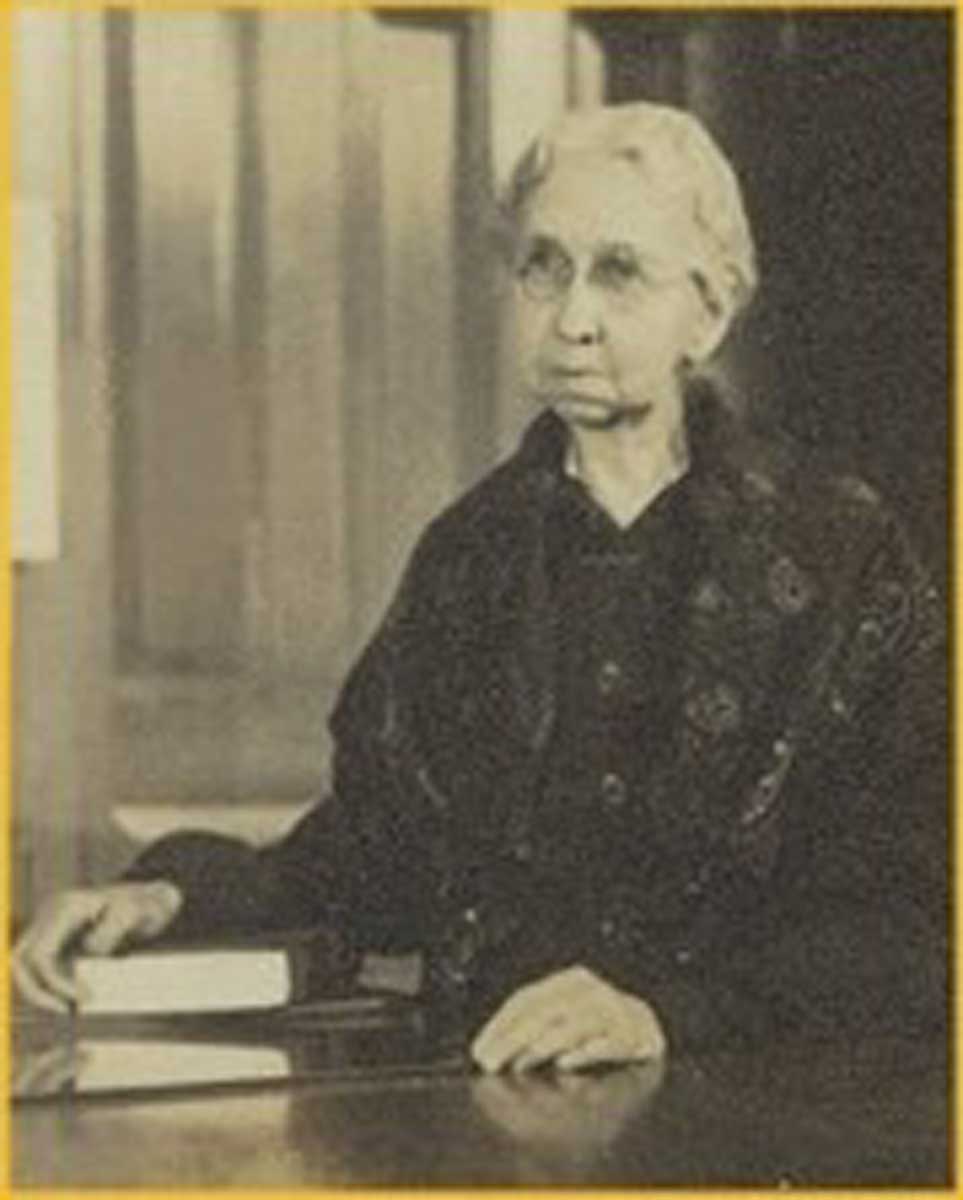
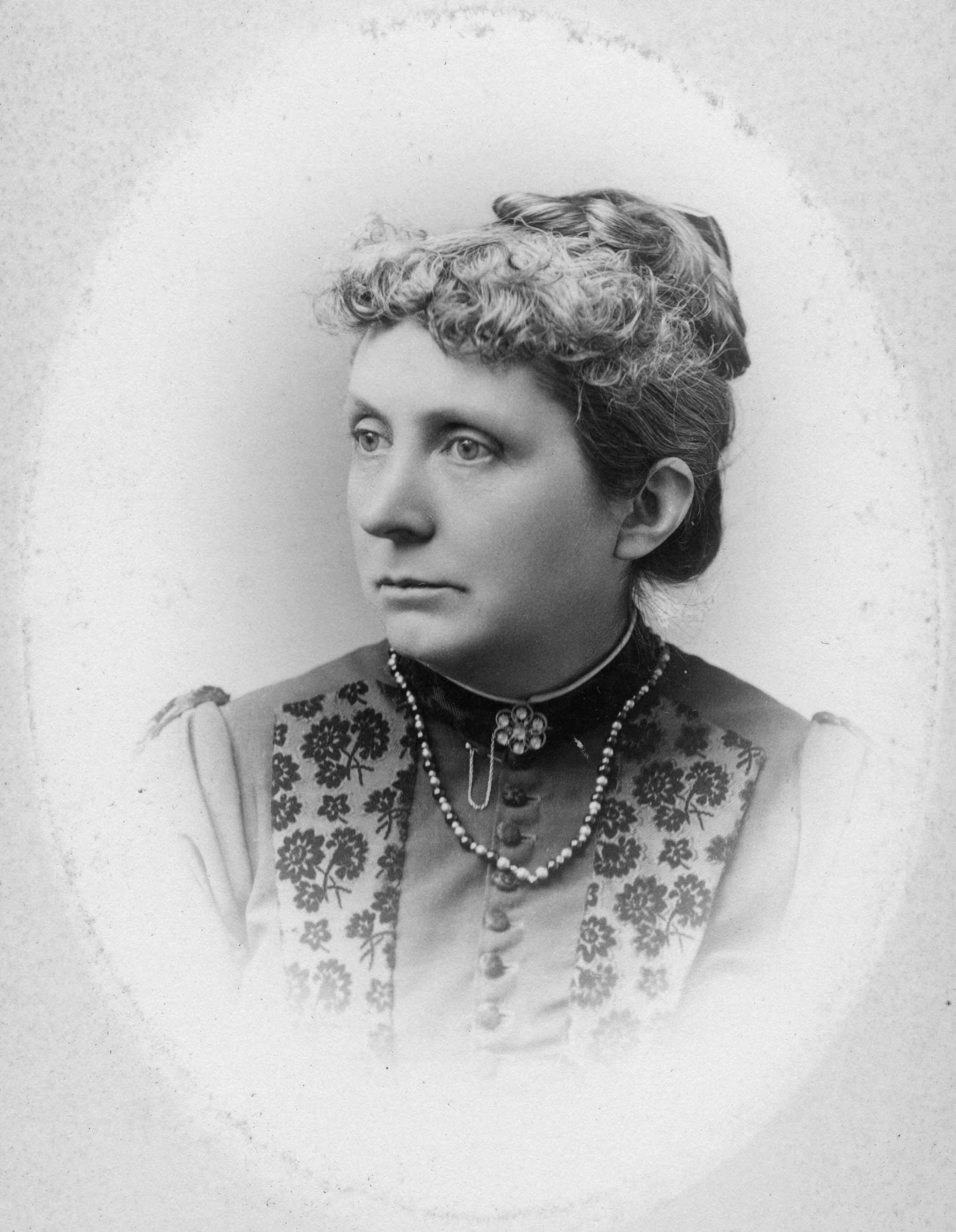
Emma F. Blood (1869-1957) had the distinction of being the longest serving head librarian at the Groton Public Library and the first Town Diarist. She was born on December 1, 1869 to George Danford Blood and Mary Jane Phelps. Emma never married and lived for many years at the “1810 House” across from Paul Matisse’s Kalliroscope Gallery. Later she boarded with Rev. and Mrs. Charles Ames.
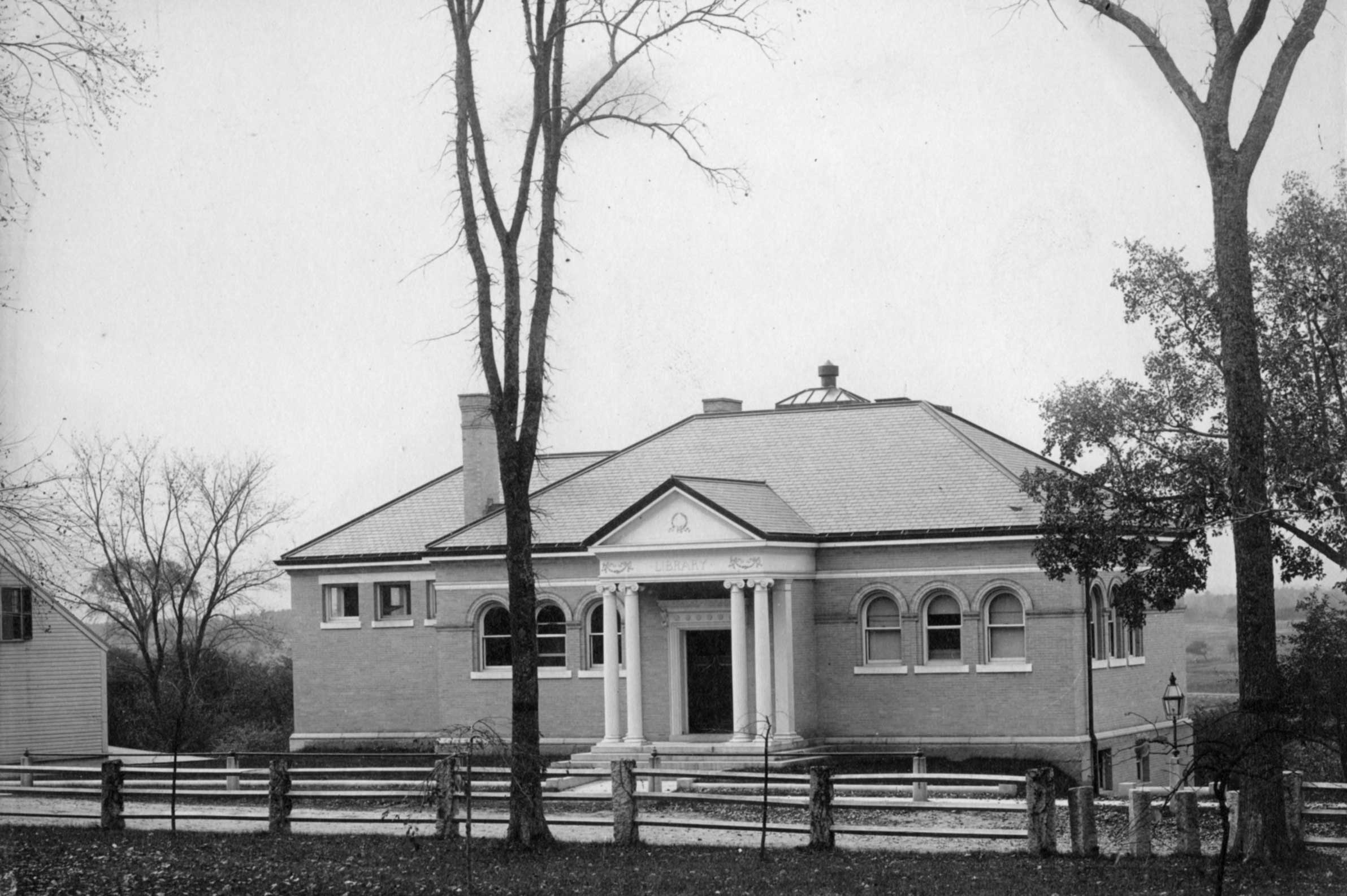
In 1891 upon the resignation of Miss Jennie Thayer, Emma Blood was appointed Librarian. The library consisted of one room in the Town Hall. Groton’s library is the eighth oldest in the State, founded in 1854. Prior to 1854 Caleb Butler maintained a private lending library and allowed residents to borrow books for a small fee. By 1855 the library had a collection of from 700 to 800 volumes. In 1860 the library moved to a room in the Town Hall. The library briefly moved again to Liberty Hall, on the corner of Main and Court streets and grew to 2,500 books. The Groton Public Library returned to Town Hall in 1876.
Emma Blood served as Librarian from 1891 until 1948, for fifty-seven years. During her remarkable tenure she oversaw the construction of the library at its present location. Mrs. Charlotte A. L. Sibley offered a site and $4,000 for the new library building. Later. Mrs. Sibley gave an additional gift of $8,000. The cost of the completed library with land, building, and furnishings amounted to $27,500, of which the Town contributed $15,000.
About Emma Blood, Helen McCarthy Sawyer quotes Rhody Park’s observations: “a nice, little bit of a lady, a rather prim person who often wore a dress or blouse with a round collar and cameo pin.”
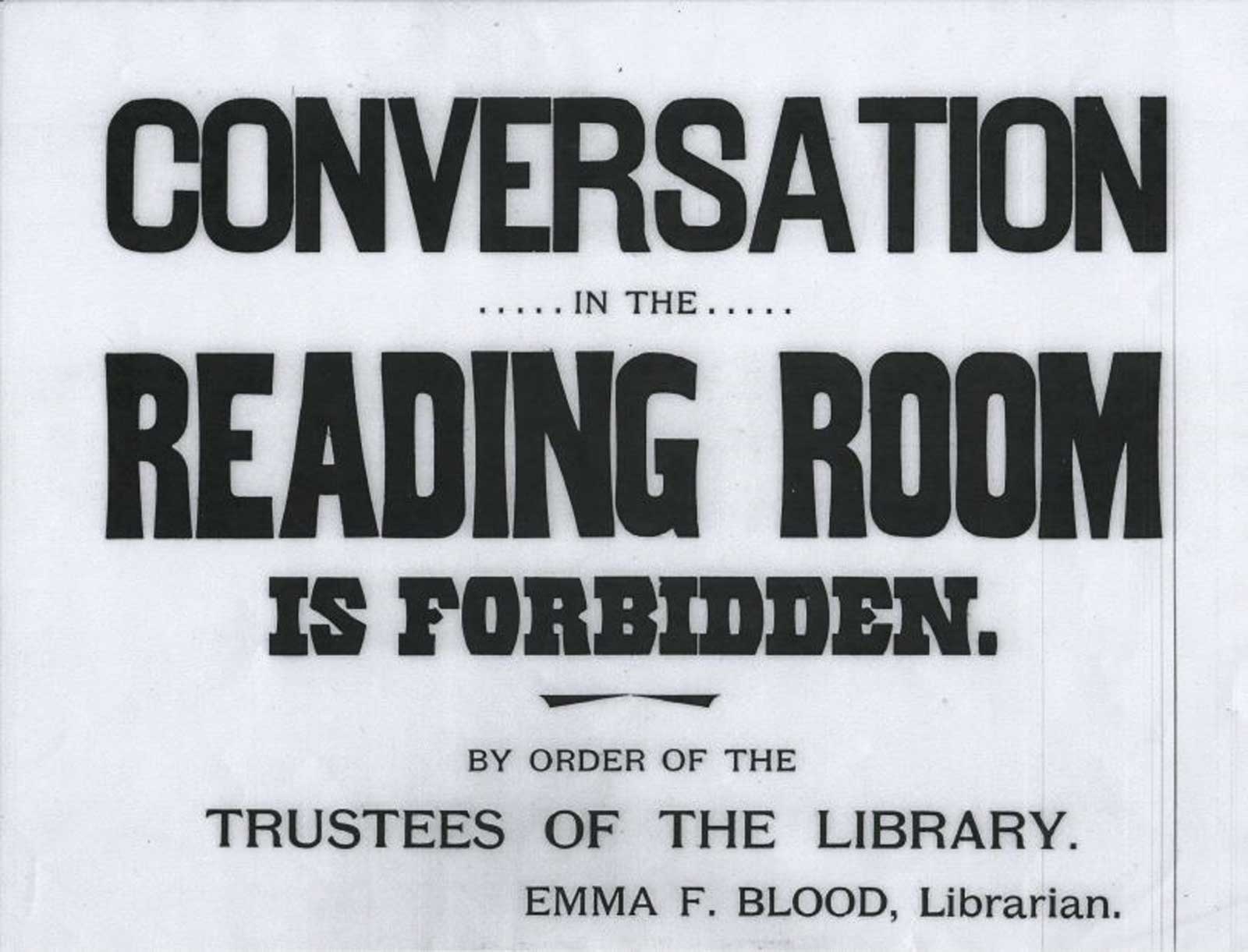
During her tenure the library strictly enforced its rules of decorum. The Library today maintains one of her signs in the Historical Room, “ CONVERSATION….IN THE….READING ROOM IS FORBIDDEN. BY ORDER OF THE TRUSTEES OF THE LIBRARY. EMMA F. BLOOD, Librarian”.
Emma F. Blood served as the first town Diarist, beginning in 1918 until 1924. During these years she documented the efforts of Groton’s citizens to provide comfort to soldiers serving in Europe, such as the number of knitted items completed by the Groton Branch Red Cross. They were allowed to provide these items to Groton’s own men who were called under the new draft. Emma Blood also documented closures of the library for the influenza epidemic and coal shortages. Her handwriting is neat, precise, and easily readable. Today, all the Town Diarists’ entries can be found at the library upon request.
By all accounts Emma F. Blood was a remarkable woman loved and admired for her work at the library and as Town Diarist.
Georgianna A. Boutwell - A Social & Cultural Reformer
-
- Georgianna A. Boutwell
Georgianna A. Boutwell (1843-1933) was born on May 18, 1843 to George S. Boutwell and Sarah A. Thayer. She lived her entire life on Main Street in Groton, save for the years she spent with her father in Washington D.C. at the height of his political career.
Georgianna attended school in Groton including years at Miss Clarissa Butler’s School and Lawrence Academy. She later attended Salem Normal School (now Salem State Uni-versity) to earn a teaching degree. She taught briefly in Lunenburg and at Roxbury Latin School before turning down a position at Vassar College to pursue other interests.
She spent the remainder of her life involved in social services, rights for women, and organizations that bettered the state of Massachusetts and her hometown of Groton. The organizations she was committed to include the Ladies Aid Association of the Soldiers Home, Daughters of the Ameri-can Revolution, Colonial Dames of America, First Parish Church, and the Groton Literary Club.
Georgianna died in 1933 and left the family house with its many belongings to the Historical Society which opened the building as a museum in 1939.
The Groton Historical Society wrote a memorial to her upon her death which reads in part:
Someone has called Miss Boutwell’s an interesting life. Perhaps the feebleness of the phrase is all the better descriptive. Miss Boutwell did not choose to be a mere spectator. She was living when it was a handicap to the making of a career to be a woman, yet she made a career for herself.
It is the mark of greatness not to overlook the little in aiming at the achievement of great things. Miss Boutwell loved her native town—of which it has been said that “to know Groton is to know Massachusetts and to know Massachusetts is to know the United States.” She was an active member of the Groton Public School Board, of the Village Improvement Society; one of the first organizers and the first president of the Groton Woman’s Club. The Groton Historical Society will remember her for her large part in the foundation of the socie-ty.
Her accompanying obituary remembers her as “an ardent woman suffragist and of most progressive spirit.”
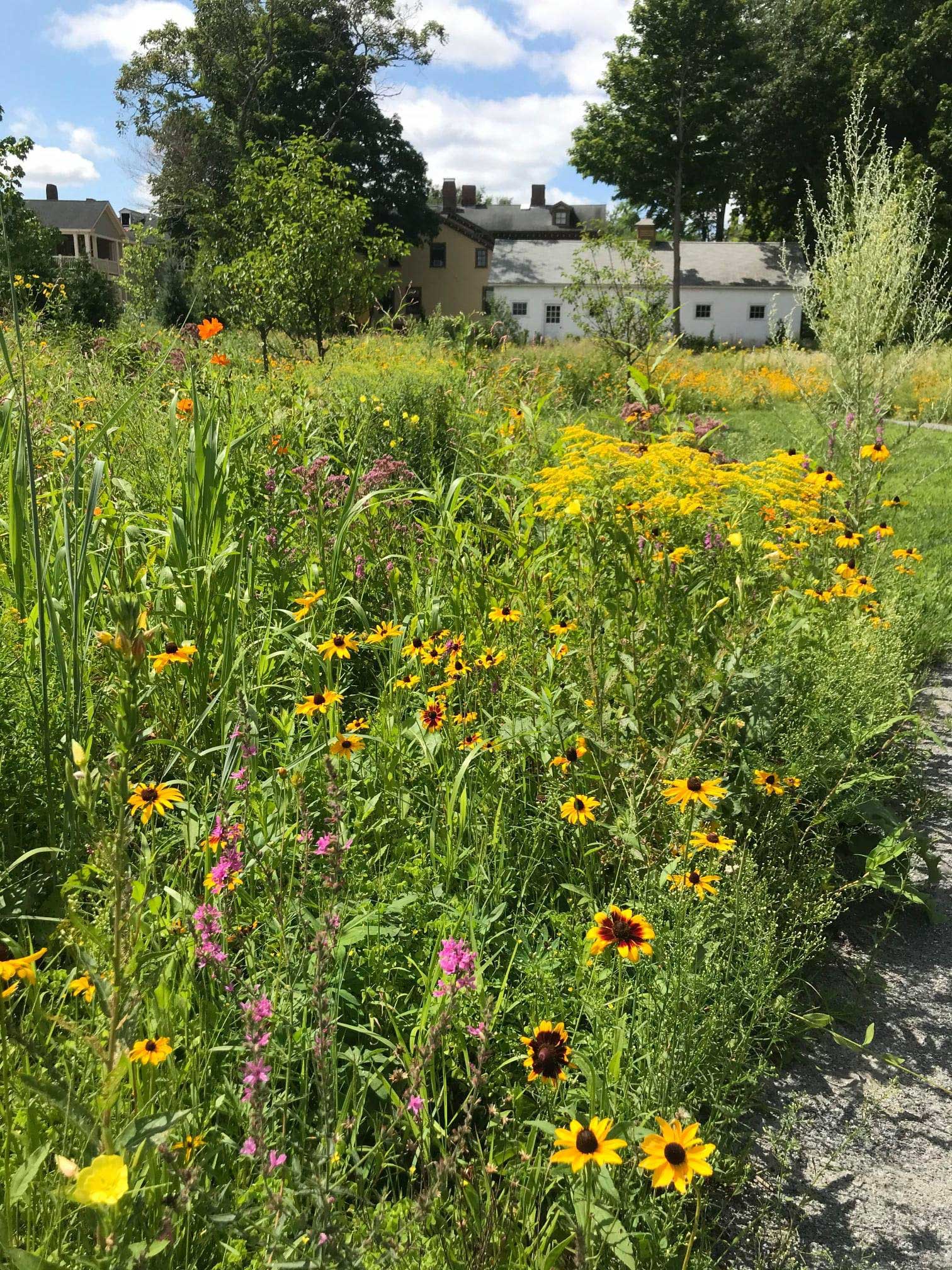
In 2018, the land behind the Boutwell House was cleared to reveal the same grand views of Gibbet Hill that Georgianna would have enjoyed during her lifetime. With the help of several local organizations, a wildflower garden was created with walking paths and flowering trees. Georgianna herself once wrote of her father: “The last summer of his life when he was over eighty-six years old, he got out of the buggy, stooped to pick some low growing wild flowers, the hot sun pouring down on him, because he knew I would like to take some home with me.” It seemed entirely fitting, then, to dedicate the new garden to Georgie, as she was called by her beloved father.
Elizabeth S. Hill - A Naturalist For All Seasons
-
- Elizabeth S. Hill
-

- Hill Farm
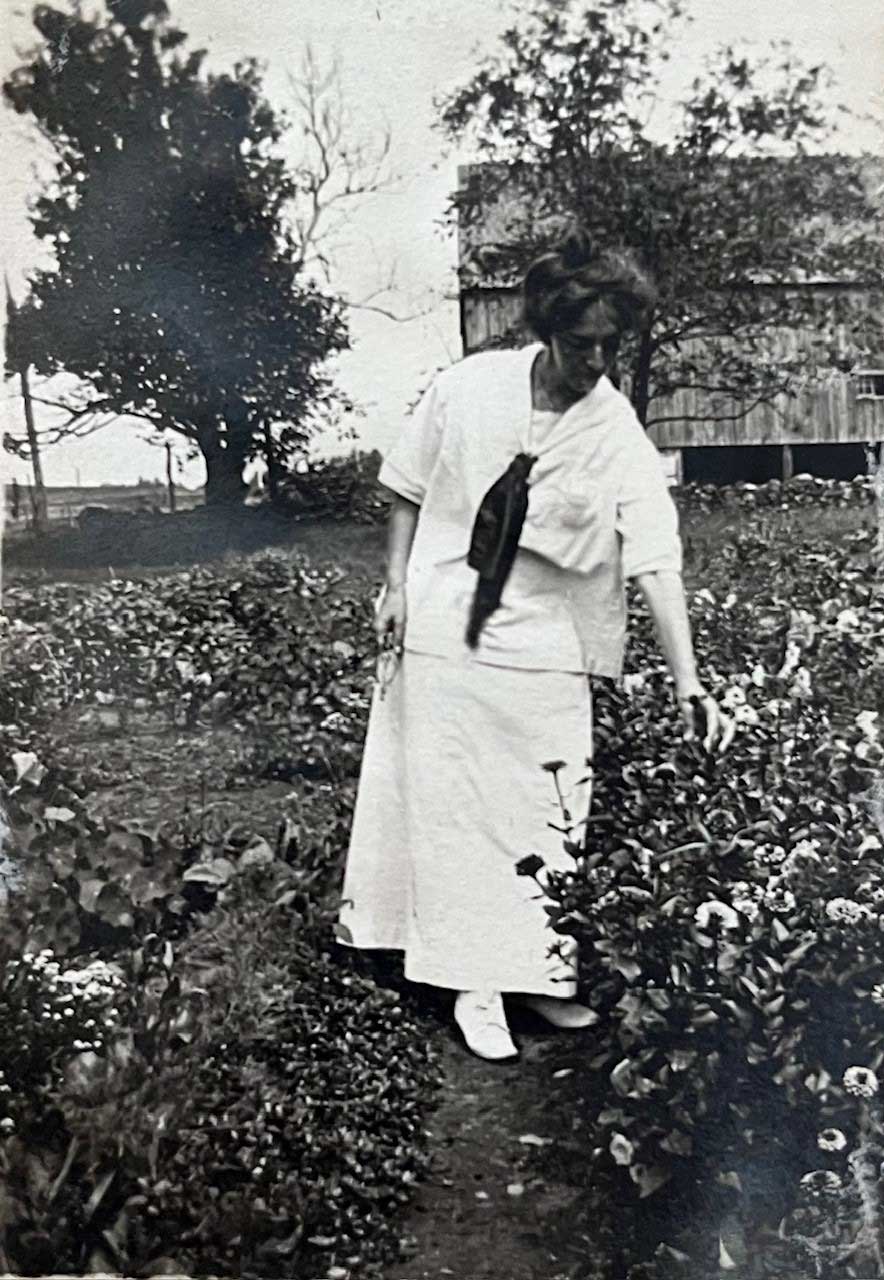
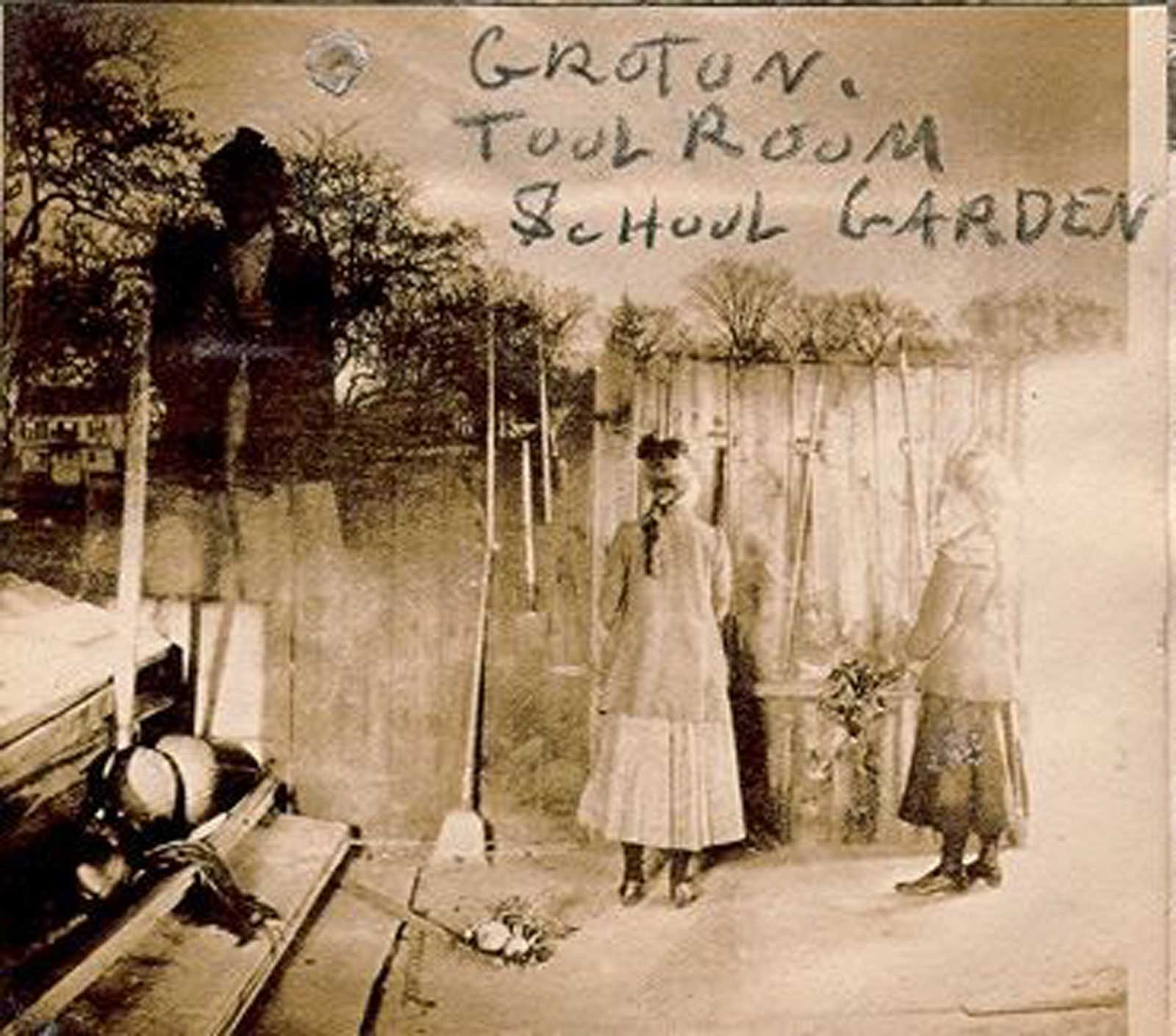
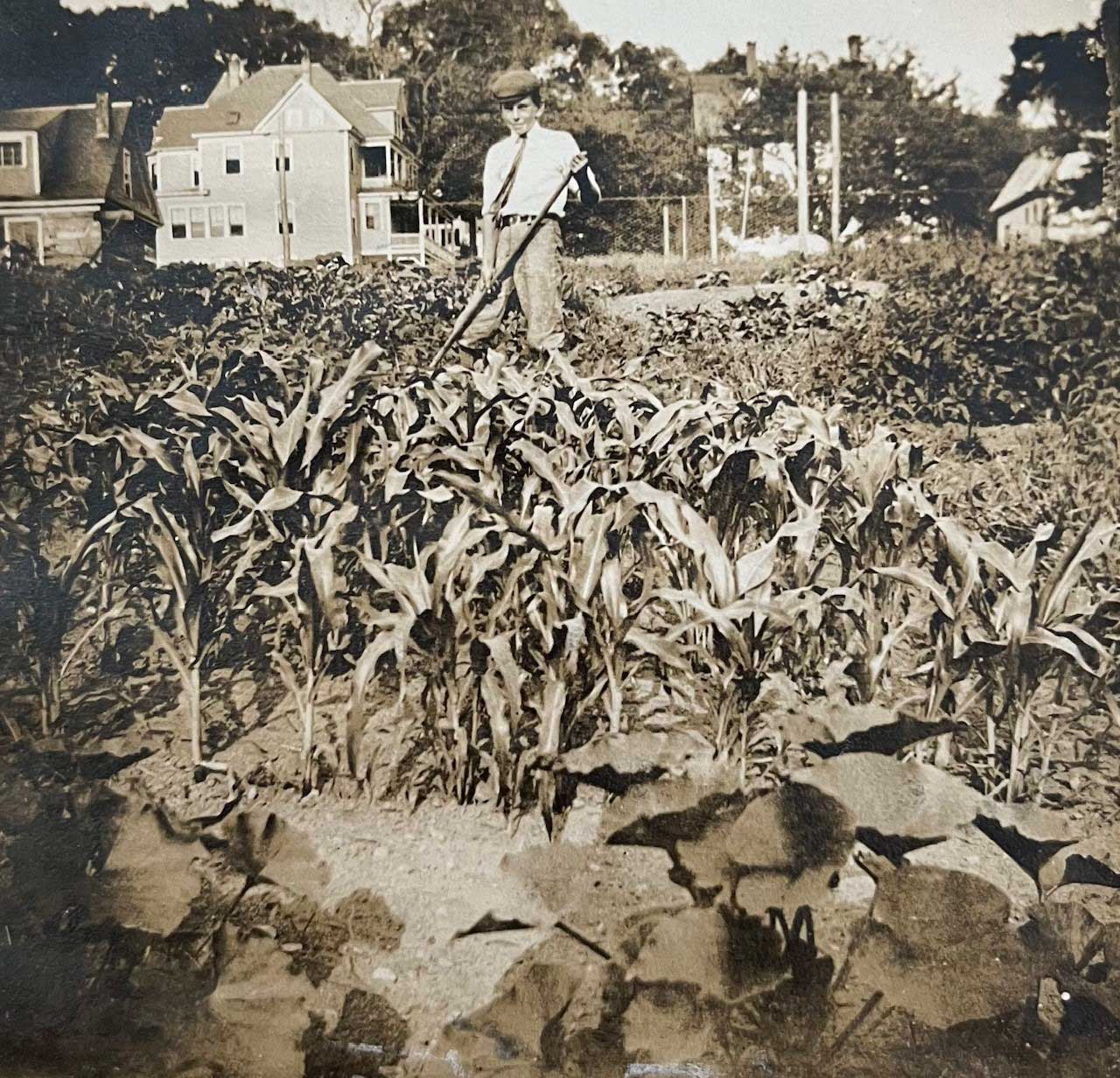
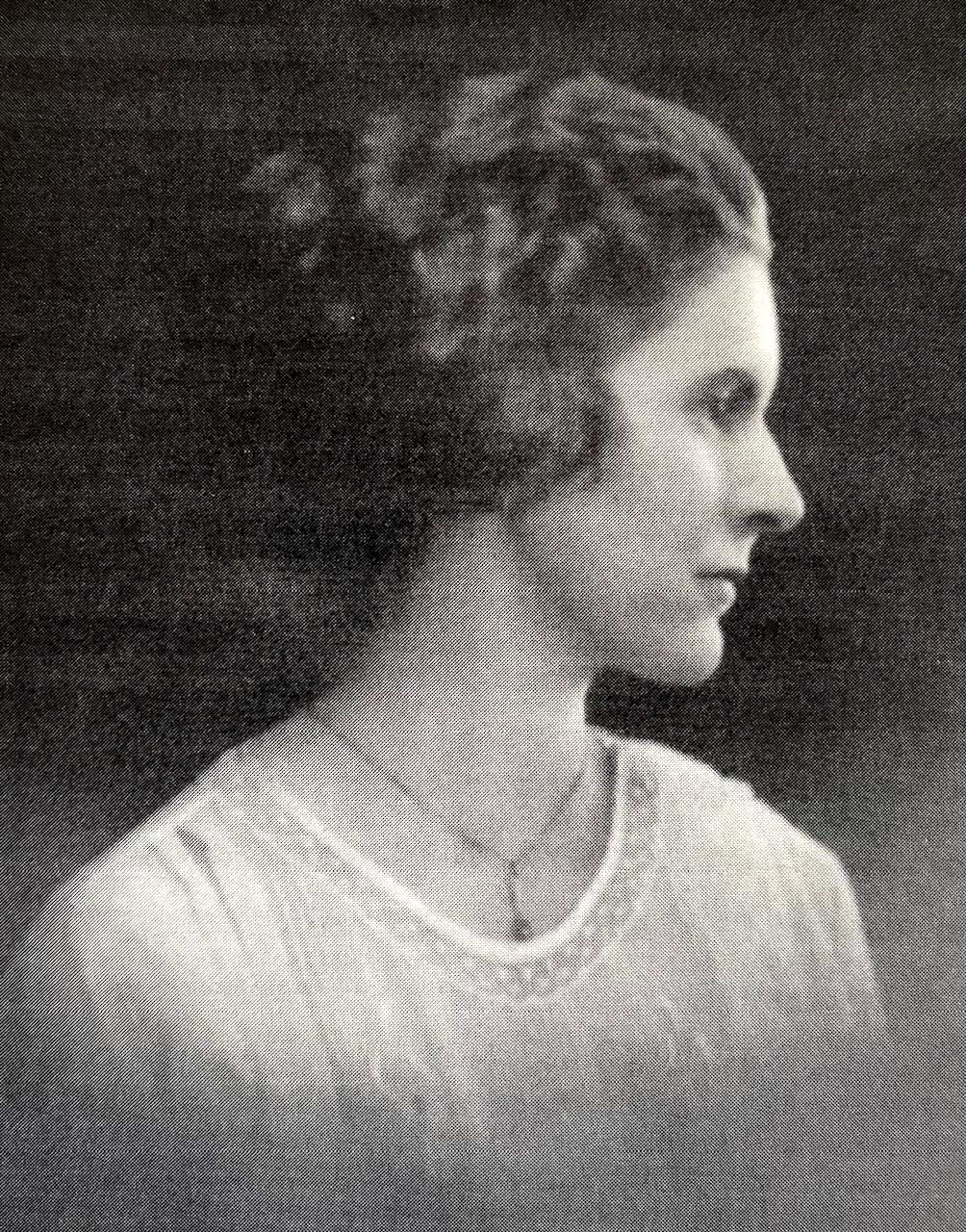
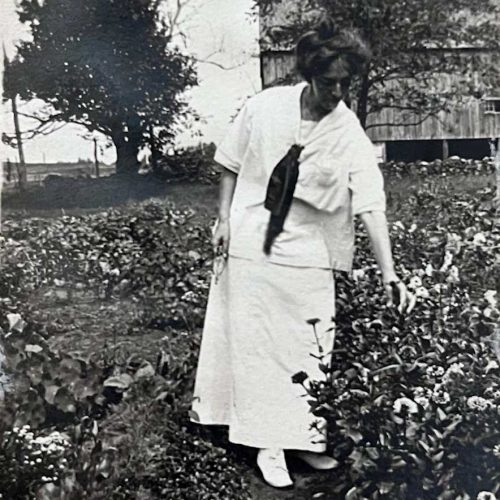
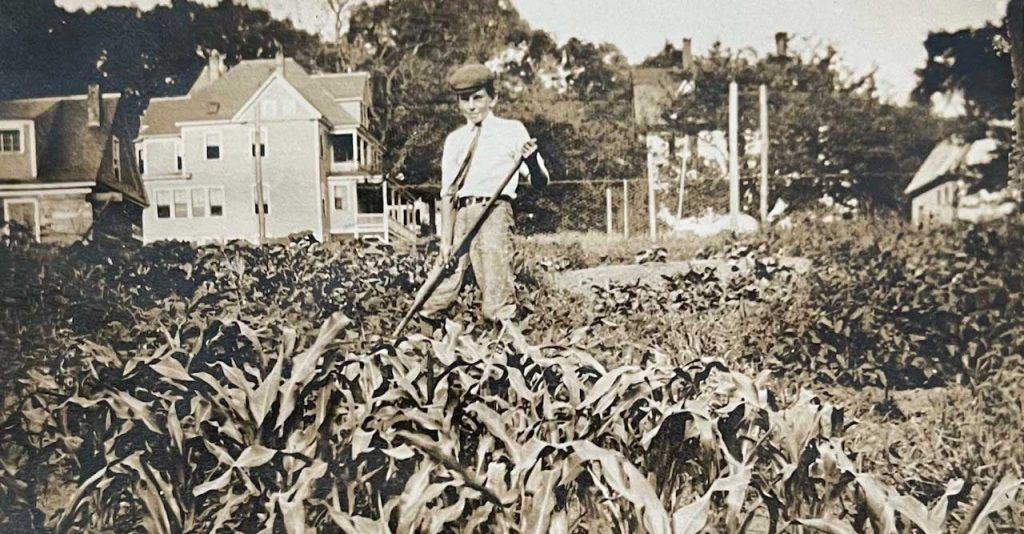
Naturalist and teacher, West Groton native Elizabeth Hill (1872-1957) devoted her life to supervising school children and women in the art of cultivating gardens wild and tame. The skills, knowledge, and curiosity she fostered were grounded in the experience and close observation of the natural world. Miss Hill is famous for the many gardens she planted (with her students) around Groton including the Lawrence Playground School Garden. Cultivated by ten-year-old boys, it was the first large school garden in the country.
A year after Harvard launched the first-of-its kind program in architectural studies for the college’s young male students, the Lowthorpe School in Groton became the first school in the country at the turn of the twentieth century to offer landscape architecture, architectural drafting, drawing, entomology and related studies to women. Elizabeth Hill was the first Lowthorpe graduate.
It was a time of firsts, when a single woman such as Elizabeth Hill, educated and gifted, could assert a spirit of independence in her career and life choices.
Between 1903 and 1918, Elizabeth Hill and her students planted innumerable gardens from one end of Groton to the other including the Mill Garden, West Groton Garden, Scout Garden, and 200 home gardens. In 1909, she became Supervisor of Nature Studies in the Groton Public Schools, as well as starting the Boy Scouts and the Campfire Girls. Positions followed as Supervisor of Nature Study & Gardening in the Brookline schools, at the Francis Willard School in Boston, and in Newton, Watertown, Melrose, and Wellesley Farms in Waltham.
In 1918, Ms. Hill left Groton to supervise nature studies and gardening in the Catskills, and subsequently in New York City. Eleven years later, she returned to take on the role of Nature Counselor working with the Scouts and adults in WPA classes at the Chicopee School. Here she taught gardening, astronomy, knitting, Latin, and as always, nature studies. She is remembered for, among other things, sharing her love of the Nashua River with her students, and for creating a wildflower sanctuary in the Memorial Forest near the river. (Destroyed by the 1936 flood, the garden was never replaced.)
When Elizabeth Hill died at eighty-five, on her birthday in 1957, Helen and Scott Nearing’s now famous book, Living the Good Life: How to Live Simply and Sanely in a Troubled World (privately published in 1952) had begun to make ripples, anticipating the back-to-the-land movement of the sixties and seventies which led in turn to the organic farm-to-table, slow food revolution that bridges the twentieth- and twenty-first centuries.
There is no question, Elizabeth Hill’s work represents a significant stepping stone in a century-long trajectory.
Leroy E. Johnson, Jr. - A Leader in Public Safety
-
- Leroy Johnson
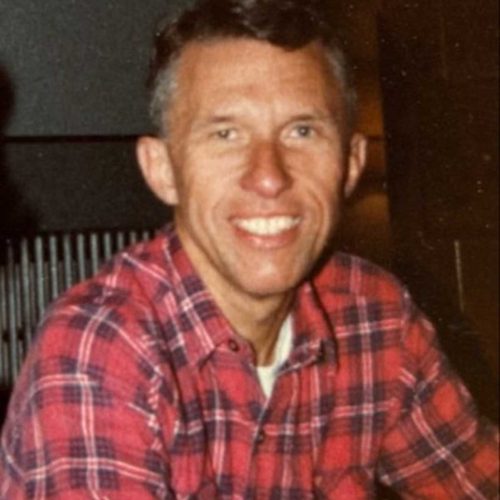
Leroy E. Johnson Jr. (1928-2023 )was born to Leroy and Claudia (McClain) Johnson. In 1939 “Movie Queen” was filmed in Groton as part of a local talent production. The short silent film features local businessowners and general shots of the town and townspeople. Young Roy himself is featured giving up his bicycle to the “hero” of the film who pedals off in pursuit of a band of kidnappers.
Roy graduated from Groton High School in 1945. After High School he pursued his interest in flying by attending flight school in Illinois and obtaining his pilot’s license. His favorite plane to fly was a seaplane, spending summers flying in and out of lakes in New Hampshire.
Roy was very involved in the Groton community. Too young to serve in World War II, he taught firearms classes to new recruits in the basement of Town Hall. He was active in the Boy Scouts and interested in survival skills. At fifteen, he was hired by the town to work at the fire station answering phones and sounding the alarms for fire and police calls. This fos-tered his love of all things fire and rescue, and in the 1950s he became the founding member of the first Groton Rescue Squad. He served as an EMT and Rescue Chief for fifty years, teaching First Aid, CPR, and EMT training and rescue techniques. As Rescue Chief, he worked closely with Groton Civil Defense. He served on the Board, was an active member of the Historical Society, and belonged to the Groton Minutemen, marching in the annual Memorial Day parade for many years.
Among other positions in the organization, Roy served as President of the Groton Historical Society from 1976 to 1978. During his tenure on the Board, the Minutes of the Historical Society are filled with notes that show Roy’s ingenuity and dry humor:
January 25, 1977 Minutes:
The regular meeting of the Groton Historical Society scheduled for Tuesday January 11, came on the evening just after a violent snowstorm. The President, Leroy Johnson, went to the Boutwell House at the appointed time and waited. As no one appeared, he decided to postpone the meeting.
July 12, 1977 Minutes:
Roy Johnson says the pigeons’ days on the roof of the Boutwell House are numbered.
October 8, 1985 Minutes:
Leroy Johnson of the Bldg. and Grounds Committee Reported that the painting and structural work has been done…Only one pigeon has been seen since the house was painted.
Roy was employed as a Toolmaker and supervisor in an experimental development shop at GenRad in Concord, MA. After retiring in 1986, Roy worked at the Groton Public Library as a maintenance handyman.
The Groton Historical Society completed an oral history project with Roy between the years of 2011 and 2012. The recordings provide invaluable insight into Groton’s 20th-century history by a true New Englander who lived through a changing landscape and community.
Virginia A. May - Writer, Teacher, Historian
-
- Virginia A. May
Virginia May’s (1897-1970) marks are all over the Groton Historical Society. She served as President of the organization from 1944 to 1947, and as Curator from 1945 until her death in 1970.
During her time with the Society she researched and wrote two books: A Plantation Called Petapawag: Some Notes on the History of Groton, Massachusetts (also known as Groton Plantation), and Groton Houses, which were edited and published by the Society after her death. Both remain trusted resources for the town’s history. The majority of the genealogical files in the Groton History Center archives were also compiled by Mrs. May. Her deep interest in local history may have been rooted in the fact that she was descended on her father’s side from twelve of the original proprietors of Groton.
At the April 10, 1945 meeting of the Groton Historical Society during her Presidential tenure, Mrs. May announced that the final mortgage payment on the Boutwell House had been made and proceeded to burn the mortgage papers to hearty applause.
Virginia May was born to Nesbit and Alice Woods on a farm on Chicopee Row. In Groton Houses, May recounts in great detail all the subsequent homes in which she lived both as a child and as a married adult including the old “Torrey Place” on Chicopee Row, “Elmwood Farm” on Boston Road, “Underhill Farm” on Old Ayer Road, and the “Robbins House” on Main Street.
Virginia began her education in a one-room schoolhouse near the intersection of Boston Road and Gay Road known as the Prescott School. When that school closed she attended the consolidated Chaplin School (now Legion Hall) and later graduated from Groton High School in 1916. Two years later, she finished her courses at Fitchburg Normal School. After teaching out of town for one year, she returned to Groton and taught in the one-room schoolhouse located at the corner of Farmers Row and Long Hill Road.
After marrying Robert May in 1921, Virginia did the bookkeeping, payroll, and other record management for her husband’s trucking company which came to be known as May and Hally. While very involved in town activities, the only official role she held in town was that of Town Diarist from 1963 until her death.
Helen McCarthy Sawyer, another Groton author and Historical Society President, wrote about Virginia May in People and Places of Groton (published 1986): “My first recollection of Virginia is as the mother of youngsters whom I taught in Groton Junior High School. A bit later I learned how active she was in the Unitarian Church where she served as President of the Women’s Alliance and as Treasurer of the Community Kindergarten, and organization she had helped found.”
In People and Places, Sawyer goes on to remember that “Virginia was a quiet, unassuming woman with a methodical mind, the kind of person whose word was her bond, conscientious and reliable…There is no doubt that [she] should be included in any series of biographical sketches, or stories, about people who have made significant contributions to the town of Groton…We and future generations owe her a tremendous debt of gratitude for her accomplishments in [the history] field…”
Otto Piene - Fire, Light, and Sky Artist
-
- Otto Plene
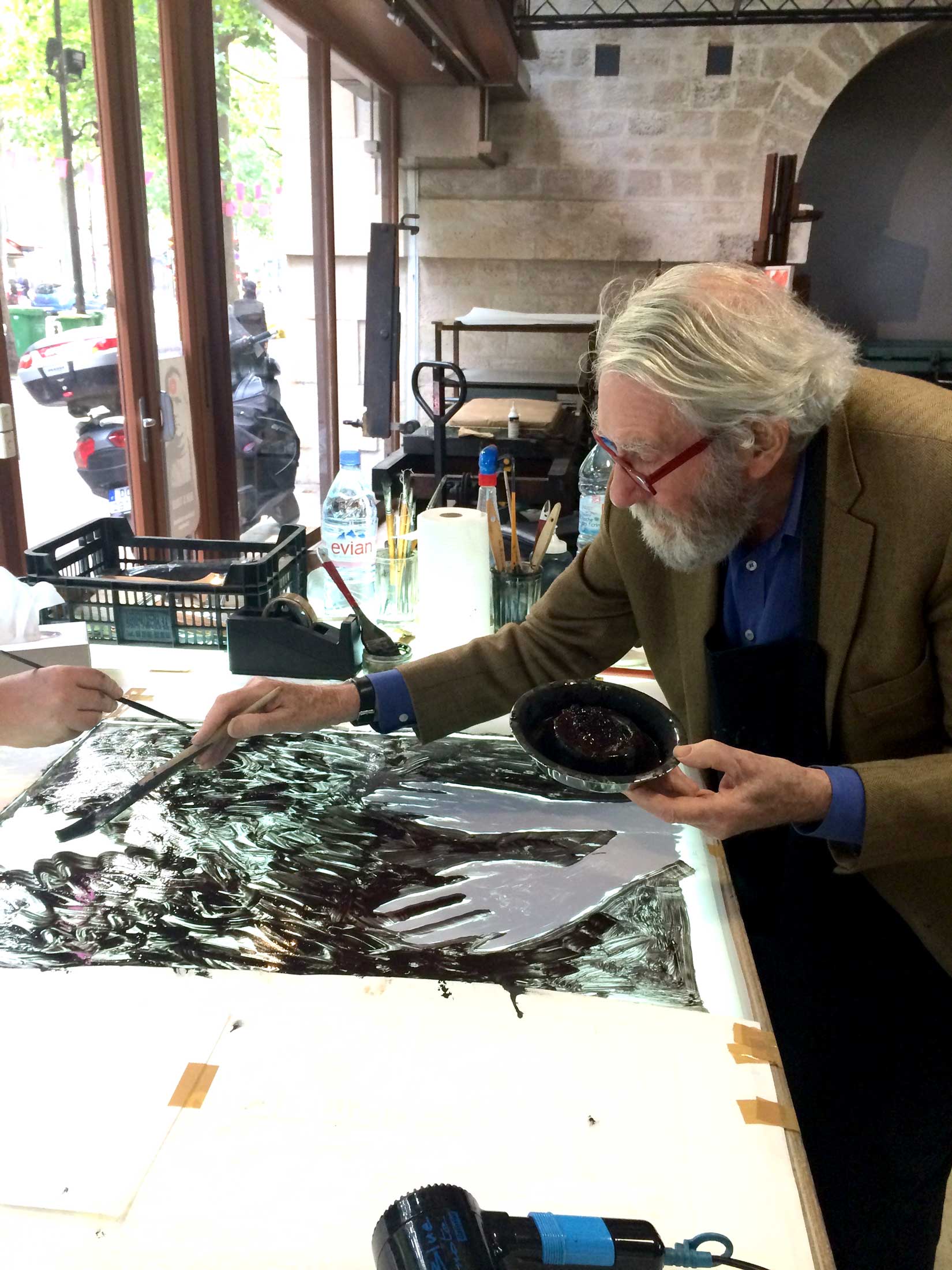
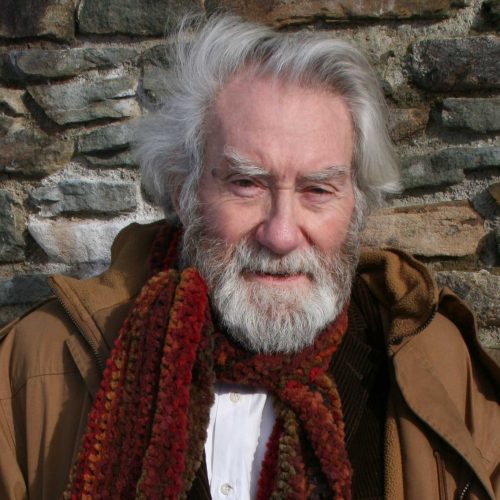
A realtor’s casual remark led the late German-born painter and sculptor, Otto Piene (1928-2014) and his wife, the poet, artist, and inventor Elizabeth Goldring, to a neglected farmhouse in Groton, where they moved in the mid-eighties. Here, they realized their shared vision of a home filled with artistic ferment and possibility. An inspiration and refuge for all the solo and collaborative projects that followed.
Over twenty-nine years, the two transformed the former wheat farm into an art farm. The house, outbuildings, and additions sit restfully within a landscape that flows uphill from James Brook to an orchard and ancient trees to gardens that melt into meadow. The iconic grain silos retain their rustic vine-covered surfaces, but within harbor meditative space. Light Silo, illuminated by Otto’s kinetic sculpture which projects a choreographed play of light and shadow on the walls, is nothing short of sacred. Within Bell Silo, the oscillating sound waves from Paul Matisse’s pristine bell sculpture periodically reach a crescendo that enters body and soul.
The property speaks to Otto Piene and Elizabeth Goldring’s lifelong engagement with an art that intersects with science, engineering, and technology. Evident in his early and late fire and smoke paintings, in his famous “Light Ballet,” and “sky art”— large scale, ephemeral, participatory events such as the gigantic balloon rainbow that illuminated the night sky over Munich for the closing ceremony of the 1972 Olympic Games.
Born in Germany in 1928, Otto Piene studied painting and art education at the Academy of Arts in Munich and the Kunstakademie Düsseldorf. He graduated with a degree in philosophy from the University of Cologne. In 1957, he and Heinz Mack, later joined by Günther Uecker, founded the Zero Group, dedicated to redefining post war European art.
The Zero artists explored new modes of painting, experimenting with unusual materials, as Otto did all his life: exploring the effects of smoke, soot and heat on paint; creating sculptures that employed open space, movement, and light.
“Light is my medium,” Mr. Piene told an interviewer. “I hate objects that just stand there demanding interpretation. Previously, paintings and sculptures seemed to glow. Today they do glow; they are active. They don’t merely express something; they are something.”
Otto Piene first came to this country in the early sixties. He taught briefly at the University of Pennsylvania before becoming a fellow at MIT’s Center for Advanced Visual Studies (CAVS), dedicated to the collaboration between artists and scientists. Under Otto’s twenty-year direc-torship from 1974 to 1994, the CAVS expanded its commitment to the ephemeral, ritual, and social nature of public art.
Otto possessed an elegance of manner, and a dynamism of spirit and intellect that drew stu-dent-collaborators and colleagues to the art farm in Groton.
Otto Piene received international recognition including the coveted American Academy of Arts and Letters Award. His groundbreaking work belongs to the collections of the Museum of Modern Art and the Metropolitan Museum, in New York, the Art Institute of Chicago, the Centre Pompidou, Paris, and the Harvard Art Museums, among countless others. The major retrospective, “Otto Piene, More Sky,” in Berlin, in 2014, honored Otto’s contribution to postwar German Art. His life’s work continues to be the subject of exhibitions and publications.
Harvey Sargisson - Master Teacher & Craftsman
-
- Harvey Sargasso
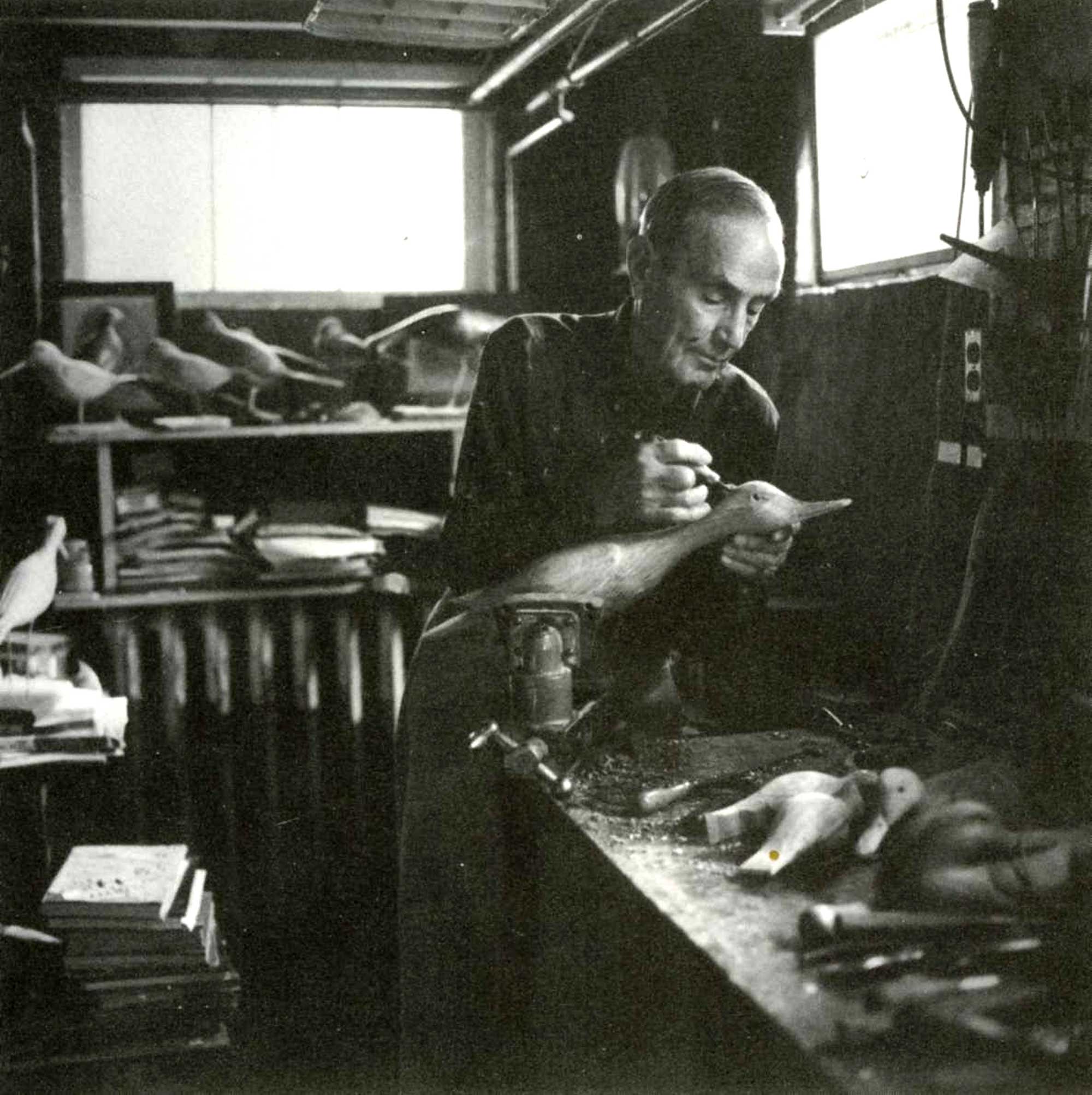
Harvey Sargisson (1902-1987) was one of the precious few who has significantly enriched individual lives as well as the life of the entire community. He was a gentle man, made of sturdy stuff, incorporating the strength and down-to-earth goodness of his mid-American heritage with uncommon talent and sensitivity. Harvey possessed an incredible capacity for giving of himself; a genuine selflessness which was matched by his appreciation and affection for those who went out of their way to assist him as he worked for the betterment of the Groton community.
Harvey’s talent is legendary, but it wasn’t his talent that made him special. Harvey’s handiwork was an expression of his love for and intimacy with the natural world. He welcomed the woodcock in the spring, thrilled to the flush of a grouse; he knew when the trout would rise and where the butternut grew. Little gave Harvey more pleasure than sharing his knowledge as well as his favorite woodland haunts with students, colleagues, and friends. When Harvey crafted a bird or fashioned a lowboy, there was nothing abstract in the exercise. It wasn’t just a likeness of the species; rather, it was an interpretation of a particular bird seen at a certain time in a certain place. The lowboy, too, was made from an individual tree with a history that Harvey knew and which embodied a set of experiences that were personal, significant, and enduring. Harvey derived his greatest detail in recounting the story behind the place rather than the art itself. It was the story, delivered with animation and a spark in his eyes, which endowed Harvey’s work with special substance and meaning.
In the final analysis Harvey was a teacher. Some for whom he was a mentor have gone on to becoming professional craftsmen themselves; building as much on attitudes acquired through association as on the extraordinary skills learned from the master. For the rest of us he has taught us to see more clearly, to feel more deeply, to appreciate more fully that which is pure, unspoiled, and important. He has taught us to care beyond ourselves, to leave things better than when we found them; to rejoice in the gift of life. Thanks to his contributions to the cause of education, a Town beach, named in his honor by a grateful community, and a landscaped ca-noe launch on the Nashua River are preserved as conservation land in perpetuity.
Excerpted from Eulogy given by Ben Williams, Lawrence Academy Headmaster, 1987
Harvey Sargisson taught Industrial Arts (woodworking) at the Groton School from 1944 to 1970. He is well known for his carved birds, a number of which are in the collection of the History Center. In addition to birds, Sargisson built furniture such as beds, tables, and chairs. The majority of the wood for his projects came from trees grown in Groton. Additionally, he served on the Town of Groton Conservation Commission from 1966 to 1971 and was designated an Honorary Lifetime Member.
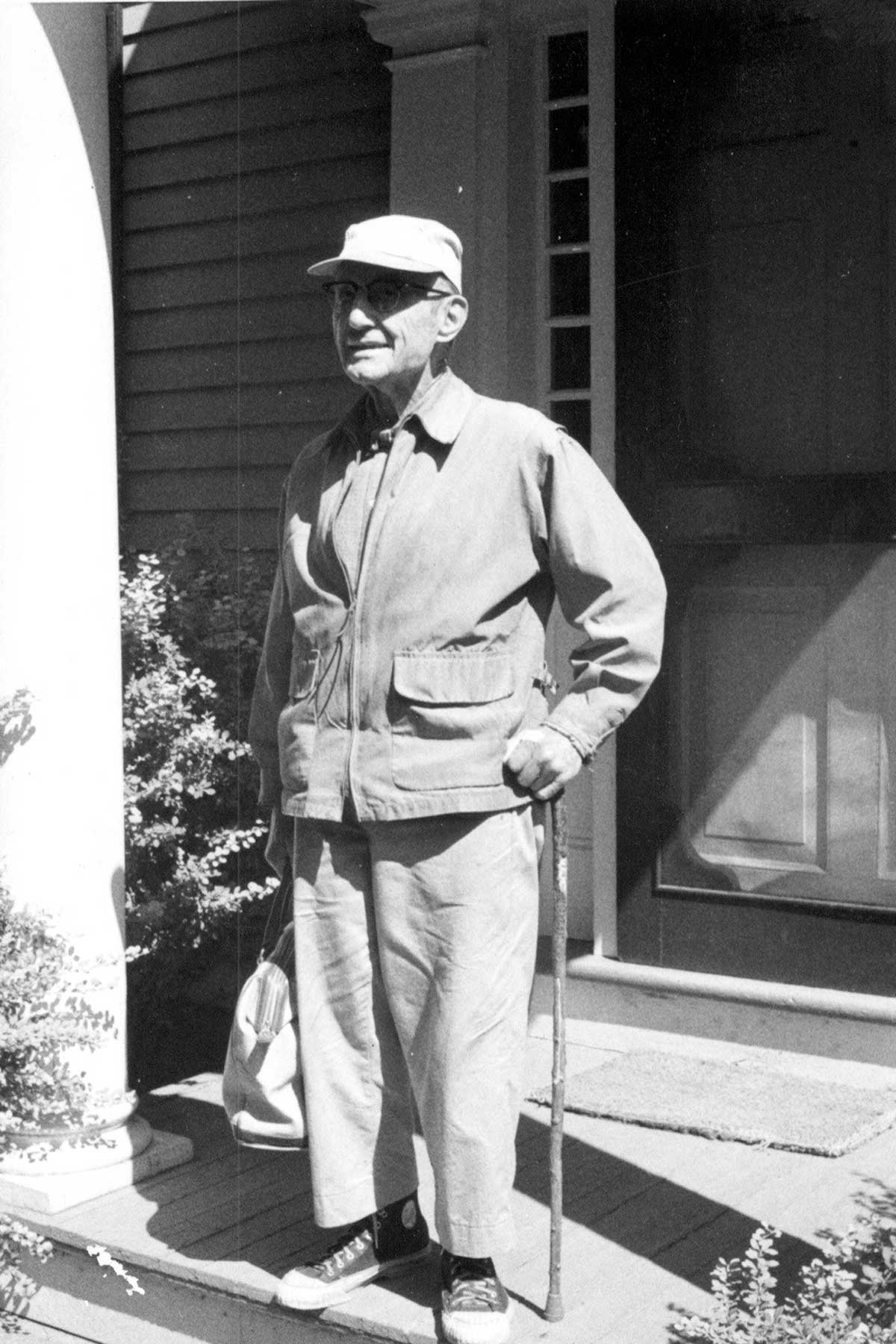
William P. Wharton - Conservationist & Naturalist
-
- William P. Wharton
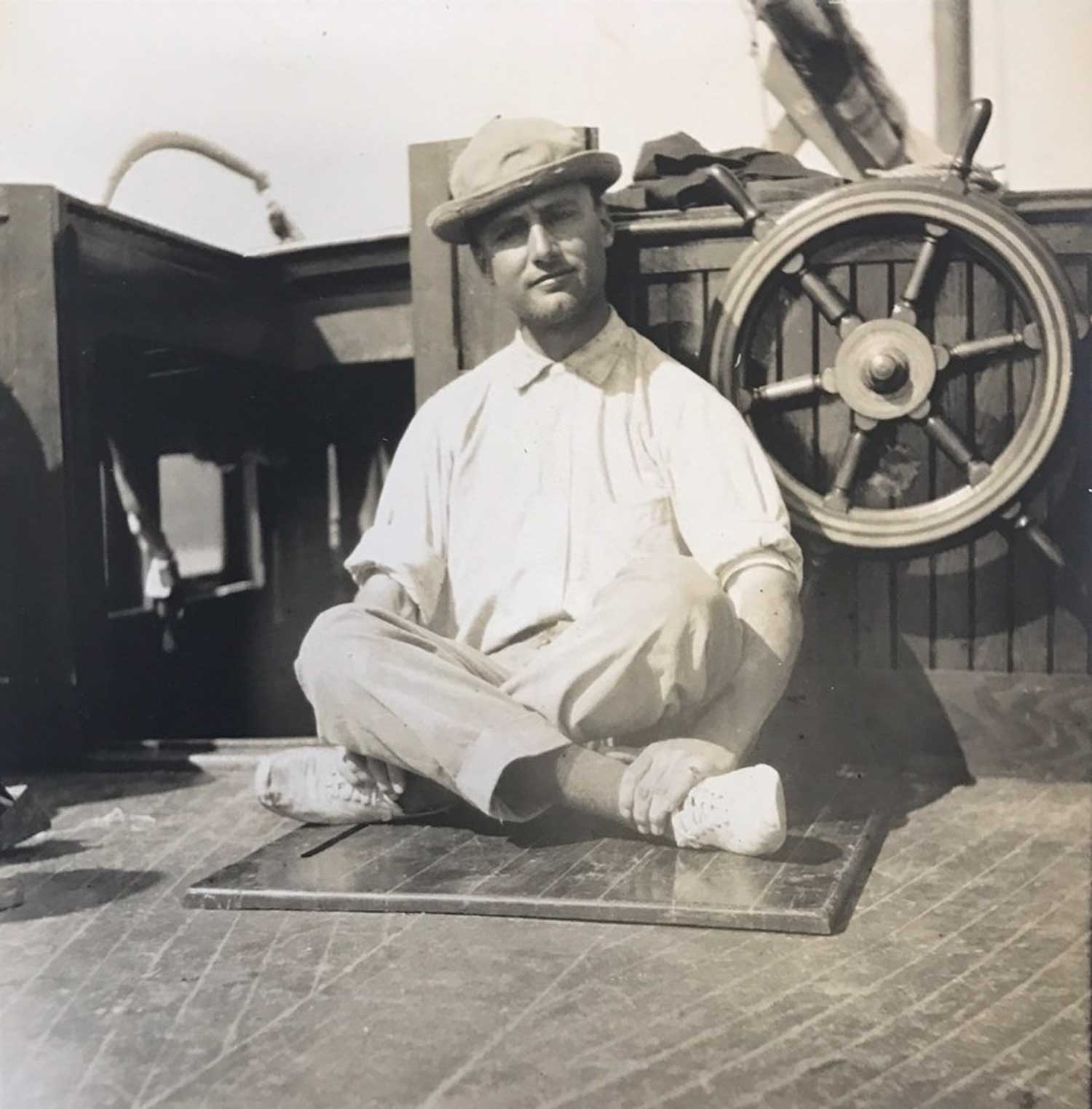
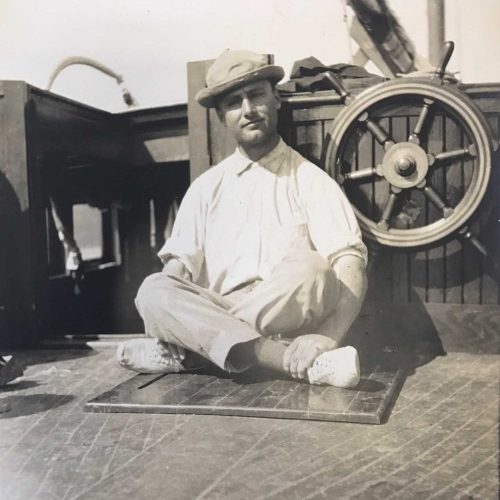
“I’ve never found anything more interesting in my 90 years than my work in conservation.” These words in 1970 from William P. Wharton (1880-1976), who would live another six years, speak of the passion that left an important national and international environmental legacy. Much of that work was done in Groton.
Wharton came from a wealthy old Boston family who had summered in Groton. He went to Groton School, a classmate of FDR. After graduation from Harvard College, he started buying land around Baddacook Pond and built a cabin there. By 1910 he was living at his Five Oaks Farm on Broadmeadow Road in Groton and connected to a group, “The Wood Ticks,” who had formed The Society for the Pro-tection of New Hampshire Forests.
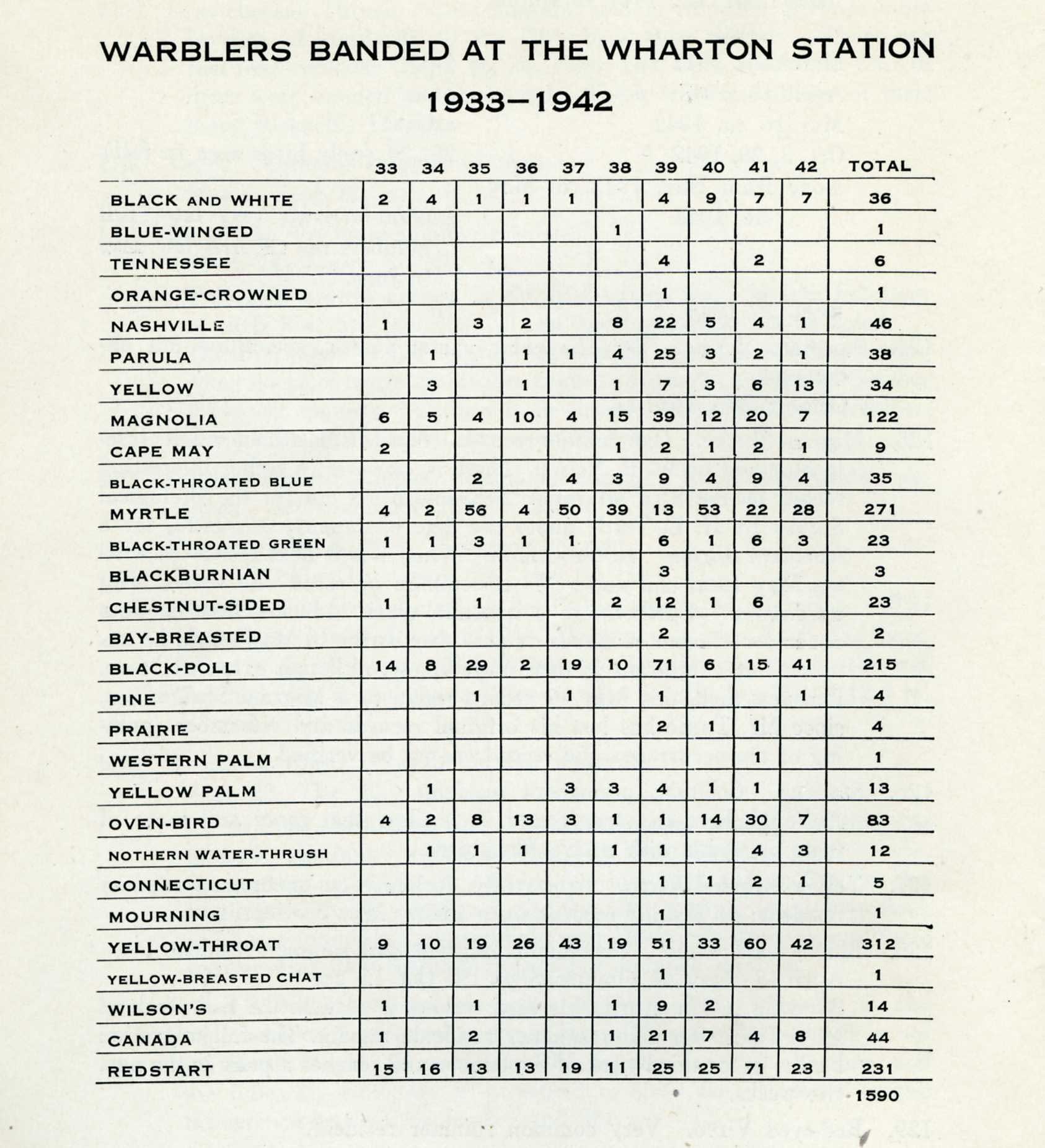
Wharton had many conservation interests. They included the Florida Everglades, redwood forests, and preservation of bison on the Great Plains. He lobbied in Washington for a study of Dutch elm trees as Groton’s Main Street trees succumbed to the disease. He had one of the first Federal bird banding permits, and established a bird banding station at Five Oaks Farm. He was an officer of the National Audubon and director of the Massachusetts Audubon Society 1912-1927.
As a Boy Scout, the late Groton resident Roy Johnson helped in the bird banding at Five Oaks Farm. Later as an adult Explorer Scouts advisor, he had 10,000 white pine seedlings to plant. He recalled William Wharton taking him to find places for the trees at the new Town Forest, which Wharton had helped establish in 1922. On the drive in they had to stop because they saw a very rare bird, a Pileated Woodpecker. Wharton told him, “You are a grown man now; you can call me Billy.”
Wharton continued to buy up property, especially during the Great Depression as some people gave up farming. He experimented with tree planting on his Baddacook Pond Wharton Plantation.
The Hurricane of 1938 leveled 3/5 of the forest in New England. There was no market for that much downed wood, so the Federal government bought up timber as it could be harvested. Wharton stored some of this timber on his property. The decade’s tribulations ended with drought. On a windy April 1941, the woods in Groton caught fire. It was five days before the blaze could be controlled. Most of Wharton’s stored timber and his trees were lost. After this event, he was inspired to apply the known scientific techniques of forest management. In 1944 he formed the New England Forestry Foundation (NEFF). In 1968 he donated his 722-acre Wharton Plantation to NEFF.
William Wharton’s legacy is still alive in Groton where more than 1,079 acres of conservation properties in Groton are held by NEFF, in addition to properties owned by the Town of Groton Conservation Commission and Town Forest Committee, the Groton Conservation Trust, the Massachusetts Audubon, Society, and the Commonwealth of Massachusetts, for a total of 8,093 acres of permanently propertied conservation land.
Excerpted from an article by Mary J. Metzger which ran in the Groton Herald 4/12/2017